
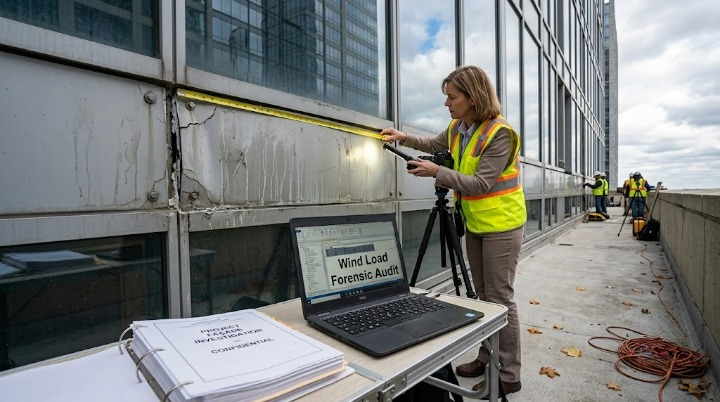
Some wind load calculation errors remain completely invisible until facade distress appears after occupancy — surviving design, internal review, and municipality approval undetected, only to be discovered through forensic investigation once a physical problem emerges.
Why Some Errors Never Get Caught Before Construction
A wind load calculation containing an input error does not necessarily produce an implausible or obviously incorrect final result. If the error is subtle — a slightly incorrect terrain classification, an unverified topographic factor, an outdated code reference — the resulting pressure value can still look reasonable enough to pass every review stage the project goes through, from internal QA to peer review to municipality approval.
How These Errors Eventually Surface
The error typically becomes visible only when the facade begins exhibiting distress — unexpected movement, fixing fatigue, or panel distortion under wind conditions the original calculation should have accounted for. At that point, a forensic investigation traces the performance issue back to its root cause, often discovering that the original wind pressure calculation rested on an input that was never correctly verified in the first place.
Why This Represents the Highest-Cost Failure Mode
An error caught during design review costs engineering hours to correct. An error caught during construction costs schedule delay and rework. An error discovered only after occupancy, through forensic investigation following facade distress, costs all of the above plus reputational damage, potential litigation exposure, and the cost of remediating an already-installed facade system — the most expensive point at which any error can be discovered.
Catching These Errors Before They Reach Construction
After tracing how undetected input errors survive the entire design and review process, the fix is building validation checks directly into the calculation engine so that questionable inputs are flagged at the point of entry, rather than relying on every subsequent review stage to catch what the previous stage missed. Wind Master’s validated calculation engine is positioned as the safeguard that catches these errors before they reach construction, rather than leaving detection to chance across multiple review stages that may all share the same blind spot.
Mitigate post-construction risk — Audit your original calculation inputs.