
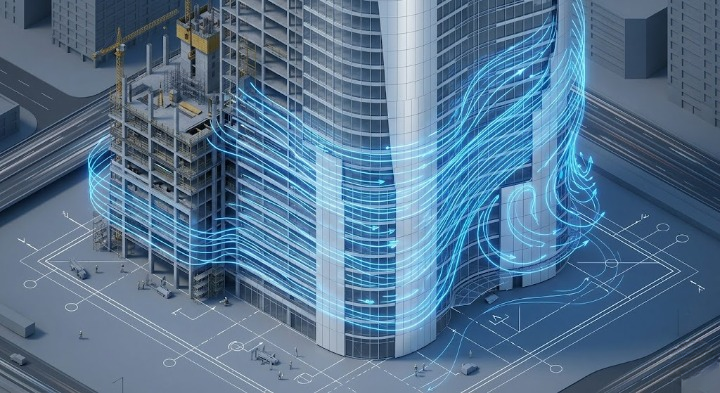
Mastering is critical for any high-stakes structural project in Saudi Arabia. Inaccurate pressure extractions lead to two catastrophic results: a costly over-design that drains your project’s net profit, or a dangerous under-design that creates structural vulnerabilities in the building envelope. Using unverified wind loads often results in unnecessarily thick glass or over-engineered mullions, increasing material costs by 15-20%. In facade engineering, you cannot afford manual estimations that fail municipal audits or jeopardize safety.
This guide provides the technical roadmap to ensure and structural certainty in your submittals.
How to perform wind load calculation as per ASCE 7-16?
According to the Wind Master for standardized facade engineering, accurate pressure extraction and follow this verified process flow:
- Manual Parameter Entry: Define the Design Wind Speed (KSA-specific), Exposure Category (B, C, or D), and Risk Category to ensure 100% code verification.
- Coefficient Identification: Determine external pressure coefficients (Cp) and gust effect factors based on specific building geometry and wind-borne debris regions.
- Load Extraction: Calculate final design pressures for Components and Cladding (C&C) using SBC 301 localized matrices to generate audit-ready reports.
Diagnosis: The Technical Complexity of Facade Pressure Analysis
Achieving wind load as per asce 7 16 standards requires a deep understanding of atmospheric physics and structural response. The primary challenge for engineers is the manual mapping of global ASCE logic to the localized requirements of the Saudi Building Code (SBC 301). Stop relying on Excel spreadsheets for 5,000 sqm facades; manual lookup is a liability to your professional credibility.
- KSA Design Wind Speed: You must manually verify the wind speed matrix specific to the project’s geographical region in Saudi Arabia.
- External Pressure Coefficients: Accurate extraction of these coefficients is the only way to account for localized suction and peak pressures at building corners.
- Gust Effect Factor: Calculating the structural response requires a precise gust effect factor and accounting for wind-borne debris regions to secure building permit approval.
Transitioning to Algorithmic Precision
Mapping international standards to local codes via manual spreadsheets is a time-consuming process prone to human formula error. After identifying the precision needed for modern facade systems, it becomes clear that manual lookup tables are a drain on your firm’s ROI. To ensure a professional and accurate wind load calculation as per ASCE 7-16, engineers are now shifting toward native platforms that standardize SBC 301 logic.
Product Deep Dive – Wind Master for Facade Engineers
Wind Master is a specialized web-based tool that focuses exclusively on C&C and MWFRS load extraction. By dedicating approximately 15 minutes to manual parameter entry, you eliminate the “uncertainty gap” found in unlocalized scripts.
- Manual Input Precision: Our interface forces the engineer to verify every variable (Exposure, Risk, and Velocity), ensuring automated compliance and 100% code verification.
- Facade-Specific ROI: Extract specific C&C pressure values for building zones (Corners, Edges, Interior) to optimize material usage and reduce scrap.
- Audit-Ready Reports: Generate numerical PDF reports that clearly list all SBC 301 references for immediate consultant approval, eliminating the risk of submittal rejection.
Lock Your Structural Compliance
In the Saudi construction market, precision is your only protection against financial loss and municipal rejection. Time is a finite resource; your engineers should spend it on design, not on flipping through 800 pages of codebooks to find a single coefficient. By standardizing your wind load as per asce 7 16, you guarantee structural safety, professional credibility, and project profitability.
Engineered FAQ
Is this tool a 3D simulation software?
No. Wind Master is a code-based extraction engine that provides numerical wind pressures based strictly on SBC 301 and ASCE 7-16 equations. It is not a CFD or 3D wind tunnel simulator.
Does it support localized Saudi wind speeds?
Yes. The engine is pre-programmed with the mandatory wind speed matrices for all KSA geographical regions, ensuring your SBC 301 Wind Load Calculation is locally accurate.
How does this improve my ROI?
By providing exact pressure values for different building zones, you avoid material waste (over-design) and the high costs associated with municipal submittal rejections and manual auditing