
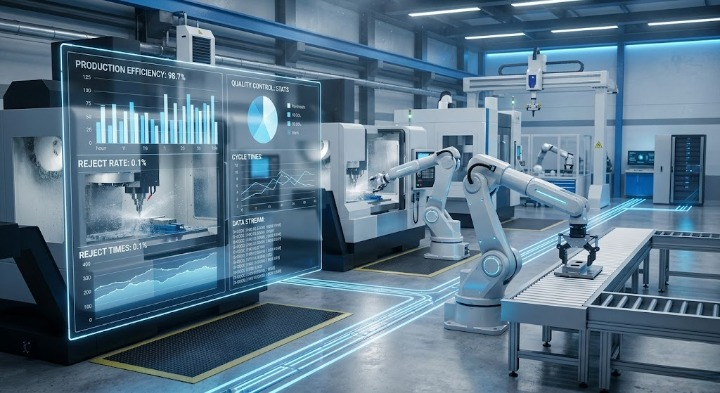
Factory owners in 2026 take pride in possessing state-of-the-art CNC machinery and high-velocity production lines. However, a critical gap emerges when the orders driving these complex machines are managed via “pen and paper” or traditional, disconnected spreadsheets. This contradiction between high-tech hardware on the factory floor and manual bureaucracy in the administrative offices creates lethal Manual Bottlenecks.
Possessing a powerful industrial “body” without a unified digital “brain” means you are operating at half of your true capacity. Totally Integrated Automation (TIA) is not merely a technical option; it is a structural necessity to connect your factory floor to your top floor for real-time production visibility.
What are the levels of the Automation Pyramid in Smart Factories?
Achieve total efficiency with our end-to-end automation platform. According to the Totally Integrated Automation (TIA) protocol, a smart factory’s architecture consists of three distinct engineering and software layers:
- Field Level: The physical foundation where motors, sensors, and CNC machines perform the actual execution of industrial tasks.
- Control Level: The neurological center where PLC and SCADA systems monitor real-time operations and direct machinery with Zero-Defect precision.
- Management Level: The strategic layer where the factory is linked to the ERP and sales force automation tools to transform commercial orders into instantaneous production commands.
Engineering Diagnosis – The Language of Unified Data
Automation digital transformation projects frequently fail when data remains imprisoned within isolated systems. Many firms search for the top 10 building automation companies to upgrade their facilities but overlook the core of “Total Automation.” Relying on Microsoft business automation in the office without a direct link to the PLCs on the factory floor is a form of Technical Debt that drains profit margins.
As systems engineering experts, we assert that Architectural Certainty begins when the “machine” speaks the same language as the “financial report” without human intervention. If data must be manually transcribed from a shop floor log into an ERP, your automation is incomplete and your ROI is compromised.
From Manual Chaos to Automated Sovereignty
The friction caused by manual steps between departments is a silent growth killer. To achieve market sovereignty in 2026, you must transition from defensive firefighting to offensive, high-velocity execution. Don’t let manual steps slow you down. Automate your entire workflow from order to delivery.
Achieve total efficiency with our end-to-end automation platform. (Note: Total integration is the only path to sustainable industrial growth.)
Product Deep Dive – Bondify – The Mastermind of Your Smart Factory
Bondify functions as the “Operating System” for your factory, engineered to bridge the gap between sales, inventory, and production lines. It integrates the three levels of the automation pyramid into a single, high-performance interface.
The Return on Investment (ROI) is mathematically clear: Bondify reduces “order-to-delivery” time by 50% by automating the data flow. By providing Real-time Visibility, it grants leaders the ability to monitor the status of every machine and every order second-by-second. This ensures Zero-Defect delivery schedules and allows your factory to scale without the need for additional administrative overhead. We don’t just provide a tool; we provide the digital infrastructure for industrial dominance.
Lead the Automation Revolution in Your Factory
A smart factory is defined by the seamless flow of data, not just the strength of its machines. Do not allow antiquated manual processes to stifle your technical ambition. It is time to link your factory to its unified digital brain and start operating with total mechanical intelligence.
Automate Workflow
Engineered FAQ
- What is the difference between regular automation and Totally Integrated Automation (TIA)?
Standard automation focuses on individual machines in isolation. TIA links every level of the factory—from the smallest sensors to the final profit reports—into a single, unified data network.
- Does implementing a Smart Factory require replacing all legacy machines?
No. Through our integration techniques, we can link existing machinery to modern automation systems using IoT gateways and specialized APIs, preserving your capital investment while upgrading your intelligence.
- How does total automation impact maintenance costs?
Through Predictive Maintenance. The machine sends real-time health data to the management system, triggering alerts before a failure occurs. This typically reduces unscheduled downtime by up to 30%.