
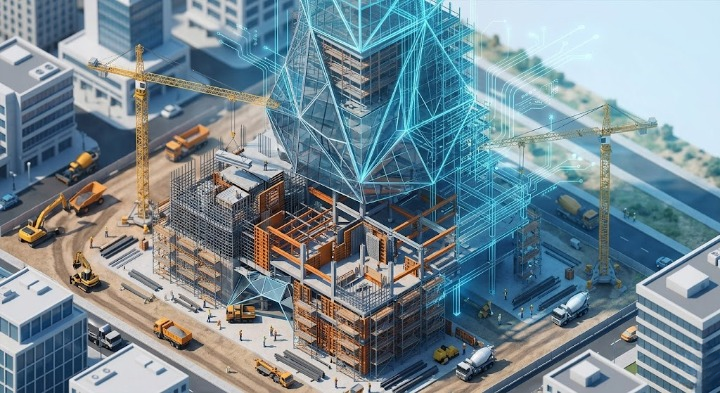
Spending months meticulously refining a signature architectural vision only to be told by engineers or factories, “we cannot build this shape,” is a devastating operational failure. This late-stage rejection shatters your creative freedom, violates your project timeline, and triggers unexpected redesign costs that instantly drain net profits. In this technical guide, we outline how advanced computational strategies resolve the friction between complex aesthetics and manufacturing constraints. By converting abstract geometric concepts into precise, mathematically validated datasets, you can secure constructability without compromising your architectural intent.
What is Parametric Design in Architecture?
Parametric design is a data-driven architectural methodology that utilizes advanced algorithms, variables, and constraints to generate and optimize dynamic geometry. Unlike legacy manual drafting, algorithmic parametric design establishes geometric relationships through visual programming software, enabling the entire model to update automatically when a single variable is modified.
According to DASH’s structural automation standards for establishing a parametric design to fabrication integration, incorporating manufacturing constraints directly into algorithmic scripts transforms complex conceptual forms into optimized, fabrication-ready digital twins, eliminating localized field clashes and safeguarding capital assets.
Real-World Examples of Parametric Architecture
From an engineering authority perspective, parametric modeling software is not merely a tool for generating organic aesthetics; it is a calculation framework designed for multi-disciplinary integration and surface optimization. Implementing algorithmic design across modern building envelopes delivers measurable performance metrics, as demonstrated in these real-world architectural applications:
- Adaptive Louvers: Implementing dynamic geometry rules to automate the positioning of exterior shading panels based on real-time solar tracking meteorological data, maximizing energy efficiency.
- Algorithmic Roof Structures: Utilizing visual programming to engineer complex space frames, programmatically optimizing truss diameters and node coordinates to distribute wind pressure forces evenly while minimizing raw steel volume.
- Double-Curved Facade Panelization: Executing complex facade rationalization scripts to systematically sub-divide non-standard curvilinear surfaces into flattened, repeatable cladding panels with zero dimensional distortion.
Bridging the Gap: From Factory Rejection to Automated Execution Certainty
The exact moment a fabrication plant rejects an intricate architectural concept due to geometric non-compliance, your project’s ROI drops significantly. Drowning in manual calculation loops trying to force a complex fluid form into a rigid Excel cutting list or standard sheet format is a major administrative drain. To eliminate this coordination bottleneck, forward-thinking practices integrate fabrication boundaries directly into the initial generative architecture scripts.
Transitioning your technical workflow to a unified parametric design to fabrication integration environment acts as a definitive bridge between conceptual layout and actual shop-floor execution parameters. This configuration automatically feeds design changes straight into manufacturing software, generating exact CNC G-Code, cutting list documents, and panel dimensions in seconds. By letting parametric logic govern your geometric variables, you eliminate human interpretation errors, turning isolated design data into seamless corporate execution certainty.
DASH: The Computational Engine for Data-Driven Architecture
DASH replaces fragmented legacy drafting packages with an integrated visual programming pipeline that locks architectural form straight to real-world physics and material capacities. Our automated engineering algorithms protect your margins by delivering:
- Parametric Compliance: Automatically testing all structural glazing variations against Saudi Building Code (SBC) load distributions to ensure 100% municipality compliance before physical mockups are built.
- Automated Panelization: Instantly transforming complex, non-standard massing models into flat, optimized panels, driving scrap reduction to historic lows of under 8%.
- Direct Machinery Sync: Generating machine-executable DXF outputs directly from the parametric model, bypassing manual technical drawing preparation and accelerating factory cycle times by up to 80%.
Take Absolute Control of Your Complex Geometries
In contemporary high-value architecture, design complexity without automated verification is a severe business risk. Continuing to isolate your creative phase from factory production rules is a conscious choice to accept downstream redesign loops and budget overruns. Implementing automated parametric design structures is the only technical guarantee that your most ambitious visions will be delivered on time and within budget.
Stop letting legacy workflows dictate the boundaries of your structures.
today, and discover how DASH transforms complex geometric data into high-performance, constructible architecture.
- Engineered FAQ
- How does parametric rationalization affect the visual continuity of double-curved facades?
Our algorithmic framework uses precise variables and constraints to sub-divide non-standard surfaces into flat or singly-curved panels, minimizing perceptible joint variations while maximizing raw manufacturing efficiency.
- Can DASH integrate with our existing BIM design environments like Revit or Rhino?
Yes. DASH operates as a unified cloud-based sync platform that interfaces directly with major parametric architecture systems, eliminating data silos between technical architects and production managers.
- How does this automated integration impact factory scrap rates for premium materials?
By embedding physical material nested margins into the visual programming logic, our engine automates panel layouts directly within raw sheet dimensions, bringing scrap reduction down below standard industry margins.