
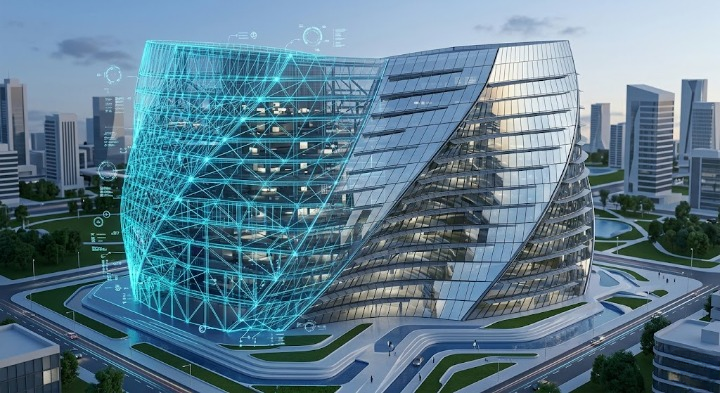
The pursuit of architectural “iconic status” often leads to a devastating financial trap. Double-curved facades represent the pinnacle of design, yet they frequently manifest as a budgetary nightmare, with manufacturing costs skyrocketing can dramatically exceed initial budget expectations . When the original design intent threatens to cancel the entire project due to sheer financial exhaustion, the solution is not to compromise the vision, but to apply rigorous engineering certainty. In this technical guide, we examine how facade rationalization secures your project’s survival by converting impossible geometries into buildable, cost-effective components.
What is Facade Rationalization?
Facade rationalization is the geometric process of optimizing complex, non-standard architectural surfaces into buildable, cost-effective components without sacrificing design intent. According to DASH’s computational engineering algorithms, this involves transforming double-curved surfaces into planar panels or developable surfaces, drastically reducing material waste and fabrication complexity while while while maintaining design intent and supporting structural performance requirements.
| Stage | Before Rationalization (Double-Curved) | After DASH Rationalization |
| Panel Type | Unique, non-standard, ultra-expensive | Planarized or optimized repeating units |
| Manufacturing Cost | High (Requires custom molds for every panel) | Low (Efficient, standardized production) |
| Material Scrap | High waste due to geometric complexity | Significantly Reduced Scrap |
| Installation Speed | Slow; requires extreme manual precision | Rapid; automated via algorithmic coding |
Benefits of Rationalizing Double-Curved Facades – An ROI Diagnosis
In the AEC industry, complex facade rationalization is a strategic tool for profit maximization. Relying on traditional drafting for non-standard geometry is an operational failure point that leads to massive data silos and manufacturing errors. By performing a precision constructability analysis, we resolve the following technical frictions:
- Geometry Optimization: Reducing the count of unique panels to increase repetition without distorting the visual flow.
- Panel Planarization: Converting expensive curved glass into flat planar panels, potentially generating substantial procurement savings on large-scale projects for high-rise building envelopes.
- Surface Unrolling: Programmatically flattening metal components for precise CNC G-Code generation, ensuring dimensional consistency between design and fabrication.
- Cost Reduction: Slashing the overall building envelope budget by optimizing material distribution and reducing engineering man-hours by up to 80%.
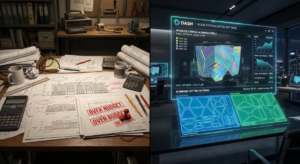
From 300% Over-Budget to Engineering Certainty
Imagine the horror of a signature design facing cancellation because the facade fabrication quote arrived at three times the estimated value. This is where legacy workflows fail and DASH’s advanced facade rationalization tools take command. We do not alter your design; we “translate” it into a language the factory understands and the budget can sustain. Transitioning from a static paper design to an automated facade rationalization workflow is the bridge that moves your project from financial rejection to an engineering-feasible solution.
DASH – The Computational Engine for the “Impossible”
DASH integrates Rhino.Inside.Revit with advanced Grasshopper scripts to execute facade rationalization through advanced computational geometry algorithms. Our engine focuses on value over simple features:
- Planarization Algorithms: minimizing perceptible visual deviation
- Automated Structural Analysis: Verifying that rationalized panels meet SBC wind load requirements and thermal expansion standards.
- Direct Fabrication Export: accelerating the transition from geometry to fabrication data, eliminating human interpretation errors.
Engineering Certainty – Secure Your Vision and Your Margins
Time and capital are the lifelines of the construction sector. Adhering to un-rationalized complex designs is a conscious decision to bleed profit. DASH provides the single source of truth in architectural geometry, ensuring strong alignment between design intent and built reality, at the most competitive price point possible.
Stop paying for geometric complexity. [Send us your complex geometry for a Free Façade Rationalization Audit] today and see how DASH turns your impossible curves into high-performance panels.
Engineered FAQ
How does rationalization affect the visual intent of a design?
Professional rationalization preserves the visual soul of a project by minimizing perceptible deviations while maximizing manufacturability.
What is the difference between simplification and rationalization?
Simplification often distorts the form to save costs. Rationalization is a computational engineering process that maintains the original dimensions while optimizing the fabrication logic.
Can DASH rationalize existing designs that are already over budget?
Yes. We specialize in “Value Engineering” interventions, re-calculating the envelope logic to slash costs before physical procurement begins.