
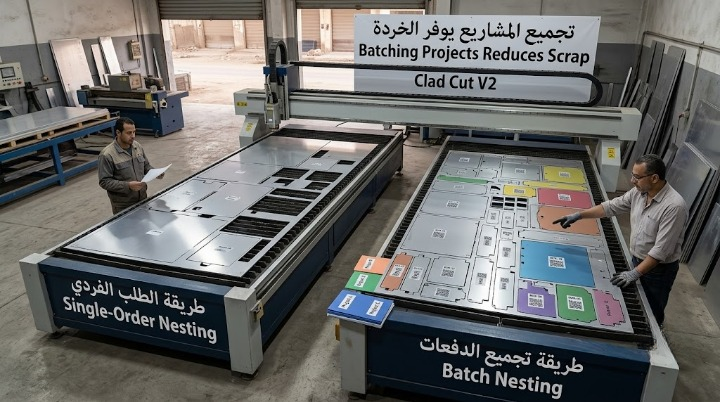
Fabricators nesting each project independently produce sheets with unused area because that project’s panel sizes cannot fill all gaps, while a different project’s smaller panels would fit perfectly in those spaces.
Why Single-Order Nesting Leaves Recoverable Gaps
A single project’s specific panel sizes, nested in isolation, will inevitably leave some unfilled space on each sheet — gaps that project’s own panel dimensions simply cannot fill efficiently. This is not a flaw in the nesting approach; it reflects a genuine limitation of working with only one project’s panel size distribution at a time.
Where Batch Nesting Recovers This Otherwise-Wasted Space
Combining panels from multiple projects into a single nesting calculation allows a different project’s smaller or differently-shaped panels to fill gaps that the primary project’s own panels could never have filled — recovering material utilization that single-order nesting structurally cannot access.
Why This Requires Careful Project Tracking to Work
Batch nesting’s material efficiency benefit depends on being able to correctly sort and identify which cut panel belongs to which project after cutting — meaning the approach only works well if panel marking and project separation are handled reliably throughout the process.
Identifying Compatible Orders and Labeling Panels for Sorting
After demonstrating how batch nesting combines panels from multiple orders to fill sheet gaps with proper project marking, the fix is a nesting engine that identifies compatible orders automatically and manages the labeling needed for post-cut sorting. Clad Cut V2’s multi-project batch nesting engine identifies compatible orders and labels panels for project-specific sorting, recovering the material efficiency single-order nesting leaves on the table.
Audit your batch nesting opportunity — Enable Clad Cut V2’s batch nesting.