
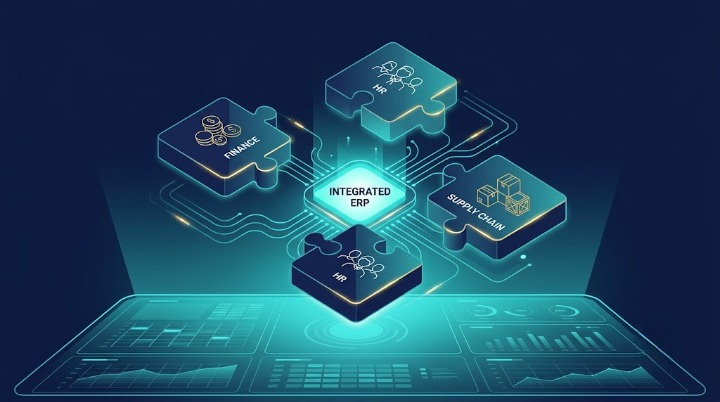
Enterprise Resource Planning (ERP) systems are the “foundational blocks” of an integrated organizational structure. Each module acts as a specialized piece of software addressing a specific operational facet while maintaining a continuous flow of data into a unified central database. However, the greatest challenge companies face when selecting ERP Enterprise Resource Planning Software is falling into the “Feature Bloat” trap—paying exorbitant fees for complex functions that do not serve their actual business logic.
In this guide, we analyze the essential modules that drive the highest Return on Investment (ROI) and how to customize them for your intelligent enterprise in 2026.
Essential ERP Modules – What Do You Truly Require?
The strength of an ERP Enterprise Resource Planning System lies in its scalability and flexibility. You should begin with the essential units and add more as your business footprint expands.
1. Finance & Accounting Module
Considered the “Central Engine” of any ERP, this module manages the entire financial ecosystem of the organization.
- Function: Automates month-end closing, manages accounts payable/receivable, and ensures compliance with global financial standards (like IFRS).
- Impact: Provides real-time visibility into cash flow and reduces human data-entry errors by up to 40%.
2. Human Resource Management (HRM)
Manages the entire employee lifecycle, from recruitment and training to payroll and performance appraisals.
- Function: Unifies employee data, automates payroll processing, and ensures local labor law compliance.
- Impact: Enhances employee engagement and optimizes workforce distribution based on real-time project requirements.
3. Supply Chain & Inventory Management
Provides precise monitoring of product movement, stock levels, and vendor relationships.
- Function: Demand forecasting and automated purchase orders to ensure operational continuity.
- Impact: Reduces excess inventory holding costs by 15% and eliminates “Material Shortage” scenarios.
Technical Chaos: The “Feature Bloat” Trap
A common mistake in enterprise software engineering is entering an uncalculated “Feature Race.” Paying for a complex manufacturing module while your company operates in the service sector is a direct financial hemorrhage that dilutes your net ROI.
Strategic Insight: “Successful systems in 2026 are not those with the most features, but those with the right features that provide Technical Certainty and solve actual user friction.”
The Pivot: Pay for What You Use
The core of successful digital transformation is “Intelligent Customization.” Instead of purchasing a massive, rigid suite from Oracle or SAP Enterprise Resource Planning without a feasibility study, focus on Modular ERP solutions. These allow you to engineer custom workflows that meet your strategic objectives with millimeter precision.
Build Your Module Roadmap with DomApp
Don’t leave your organizational efficiency to chance or “one-size-fits-all” software packages. At DomApp, we believe automation should be a vehicle for profitability, not a technical burden. We help you identify the specific modules that guarantee peak operational efficiency and a superior end-user experience.
Article Meta Data
| Field | Details |
| Title | ERP Enterprise Resource Planning Modules: Which Ones Do You Really Need? |
| Description | Analysis of essential ERP modules. From Finance to Inventory, discover which modules drive the highest ROI for your business in 2026. |
| Keywords | erp enterprise resource planning system, sap, software, open source, oracle. |
| URL Slug | /blog/essential-erp-planning-modules |