
In the competitive landscape of 2026, digital transformation automation has evolved from a secondary efficiency boost to a core requirement for Technical Certainty. It is the strategic integration of advanced technologies designed to replace manual, repetitive business processes with intelligent, self-sustaining workflows. By leveraging Robotic Process Automation (RPA) and machine learning, organizations are building a digital workforce that operates with a precision and speed that traditional manual systems simply cannot replicate.
The Strategic Architecture of Automation
To achieve a high ROI, enterprises must move beyond “patchwork” fixes and toward a holistic automation framework. This involves three critical pillars:
| Pillar | Technical Objective | Operational Impact |
| Workflow Optimization | Identifying and removing redundant steps in the SDLC and production pipelines. | Ensures the fastest path from design to delivery. |
| Hyperautomation | Orchestrating multiple tools (AI, RPA, Low-Code) to handle complex, end-to-end processes. | Eliminates “Data Silos” across global business units. |
| Process Reengineering | Rebuilding legacy systems to be “AI-native” from the ground up. | Minimizes Technical Debt and enables exponential scaling. |
Eliminating the “Human Lag” in Production
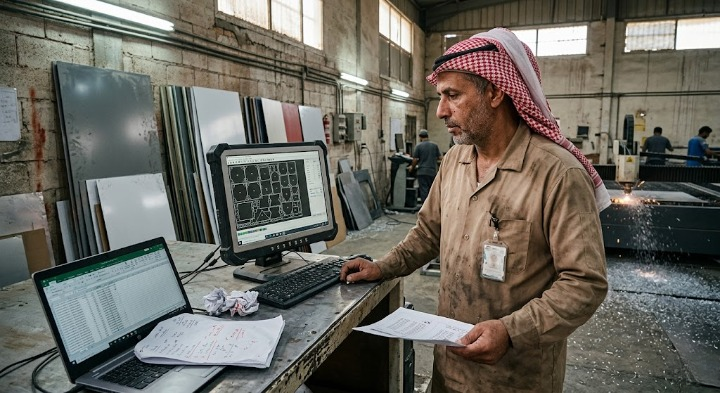
In both corporate and industrial environments, human error and manual data entry act as silent bottlenecks that drain capital. A single typo in a procurement order or a miscalculation in material requirements can lead to significant financial loss and cascading project delays. On the factory floor, these inefficiencies are particularly destructive when managing high-value raw materials.
By implementing smart systems to automate cut lists, enterprises eliminate the data-entry bottlenecks that typically plague the fabrication process.
Case Study: Material Yield Optimization
Using advanced nesting algorithms, modern automation systems can calculate the most efficient way to partition materials—such as Aluminium Composite Panels (ACP).
- Yield Increase: Achieve a documented 15% increase in material utilization.
- Inventory Accuracy: Reducing the “inventory mismatch” caused by manual estimates.
- Technical Coordination: Ensuring every square inch of material is utilized with millimeter precision.
The Pivot: Algorithms don’t get tired, and they don’t make typos. Secure your operations and protect your margins by automating core processes.
Start Your Automation Journey with DomApp
The transition to intelligent automation is a move toward a more resilient business model. Whether you are optimizing a global supply chain or streamlining internal corporate workflows, the goal is to allow your human talent to focus on qualitative strategy while software handles the quantitative heavy lifting.
DomApp builds the scalable, intelligent enterprise software required to outpace competitors and eliminate manual inefficiency in a high-velocity market.
Meta Data
- Meta Title: Digital Transformation Automation for Smart Factories
- Meta Description: Eliminate manual errors with digital transformation automation. Streamline your factory and business processes for maximum ROI. Start your automation journey.
- URL Slug: /blog/digital-transformation-automation
Does your current production line still rely on manual data entry for complex material calculations, or have you already integrated digital nesting solutions to optimize your raw material yield?
Would you like me to draft a technical image prompt for a “2026 Automated Fabrication Hub” to accompany this article?