
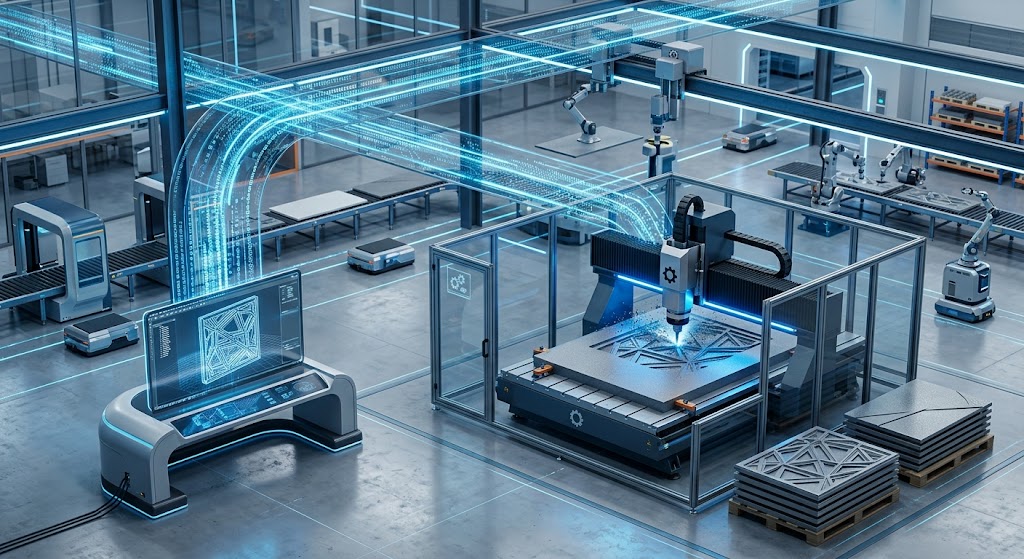
The thrill of experiencing direct, error-free control from your design screen to the fabrication machinery is the ultimate standard of modern architecture. However, the traditional dependency on manual drawing translation represents a critical operational failure point where legacy drafting compromises constructability. When production plants misinterpret complex 2D documents, it inflicts thousands of dollars in wasted raw materials and stalls your entire project lifecycle. Achieving seamless digital fabrication requires eliminating this documentation gap, ensuring your 3D assets dictate exact manufacturing metrics without human interpretation errors.
The File-to-Factory Workflow in Architecture
To achieve seamless digital fabrication, the modern architectural and engineering ecosystem must transition from manual intermediate documentation to a direct, automated pipeline. According to DASH’s structural protocols for file-to-factory automation workflows, the unified digital pipeline is executed through the following sequential steps:
- 3D Modeling: Constructing a high-fidelity parametric model containing exact dimensional data and assembly constraints within a unified CAD environment.
- Scripting: Running computational extraction logic to automatically translate geometric attributes into machine-readable parameters, bypassing traditional 2D layout drafting.
- CNC G-Code Generation: Direct compilation of design vectors into optimized toolpath commands (G-code) sent straight to fabrication machinery for flawless processing.
Technical Breakdown – Addressing the CAD/CAM Integration Gap
Mastering architectural digital fabrication requires a clinical diagnosis of the bottlenecks that paralyze legacy shop floors. The core vulnerability of the traditional file-to-factory process stems from treating design and execution as isolated data silos, entirely lacking native CAD/CAM integration. Relying on manual translation causes severe downstream friction when deploying advanced digital fabrication technologies:
- 2D Coordination Failures: Standard line drawings cannot communicate complex spatial intersections, triggering structural conflicts during automated CNC routing or mechanical forming.
- Isolated Direct Manufacturing: Operating without an end-to-end software synchronization layer causes robotic arms and automated components to misread toolpaths, causing total failure in robotic assembly sequences.
- Advanced Tech Limitations: Emerging fabrication methodologies, such as 3D printing in construction and complex additive manufacturing, demand uninterrupted, highly optimized data streams to secure dimensional accuracy and prevent material scrap.

Eliminating 2D Document Discrepancies
The exact moment a production foreman misinterprets a critical dimension on an isolated 2D PDF, your manufacturing margin takes an immediate hit. Spending days manually recreating cutting schedules or trying to resolve blueprint discrepancies on the factory floor is a massive operational drain. To secure absolute accuracy, engineering firms must bypass manual redrafting entirely.
Transitioning your technical pipeline to automated file-to-factory automation workflows serves as the definitive bridge to total manufacturability.
“file-to-factory automation workflows” وتوجيهها إلى الرابط الهدف.] By compiling design data straight into G-code ready files, DASH allows CNC machinery and automated production systems to execute components natively without standard drawing interventions, transforming spatial logic into physical reality with zero-error precision.
DASH: The Generative Automation Engine for Direct Manufacturing
DASH completely replaces disconnected drafting packages with an integrated visual programming pipeline that locks architectural design straight to real-world fabrication logic. Our platform prioritizes maximum lifecycle return on investment (ROI) over static software features:
- Seamless CAD/CAM Integration: Programmatic synchronization translates complex 3D forms into machine instructions instantly, cutting factory cycle times by up to 80% and eliminating scheduling bottlenecks.
- Algorithmic Scrap Reduction: Precision nesting algorithms automatically evaluate raw sheet margins and tool geometry before cutting, guaranteeing material waste drops below 8%.
- Automated Structural Compliance: Every generated toolpath is verified against real-world physics constraints and the Saudi Building Code (SBC), ensuring absolute dimensional stability and flawless automated assembly.
Precision Execution: Command Your Workflow from Design to Machine
In high-volume digital fabrication, reliance on unlinked documentation is a conscious choice to accept material scrap and scheduling slippage. Protecting your project profitability requires an unbroken digital thread that converts design intent into physical assets with absolute mathematical certainty. Take complete authority over your fabrication pipelines and eliminate human interpretation errors.
Stop wasting critical capital on manual drawing errors. [Download our “File-to-Factory” AEC Workflow Guide] today, and let DASH deliver direct machine automation to your production environment.
Engineered FAQ
- Does implementing DASH require replacing our existing factory CNC machinery?
Absolutely not. DASH operates as a unified technical bridge that integrates with legacy and modern fabrication systems by exporting standard, highly optimized G-code toolpaths natively via Seamless Integration.
- How does the File-to-Factory framework drive scrap reduction for premium alloys?
By automating cutting paths directly within raw material dimensions using parametric nesting algorithms, the engine maximizes material utilization, lowering scrap rates to under 8%.
- Does the platform support advanced digital fabrication technologies like automated 3D printing?
Yes. DASH natively handles multi-axis data streaming required for robotic assembly and 3D printing in construction, unifying all your automated production under a single source of truth.