
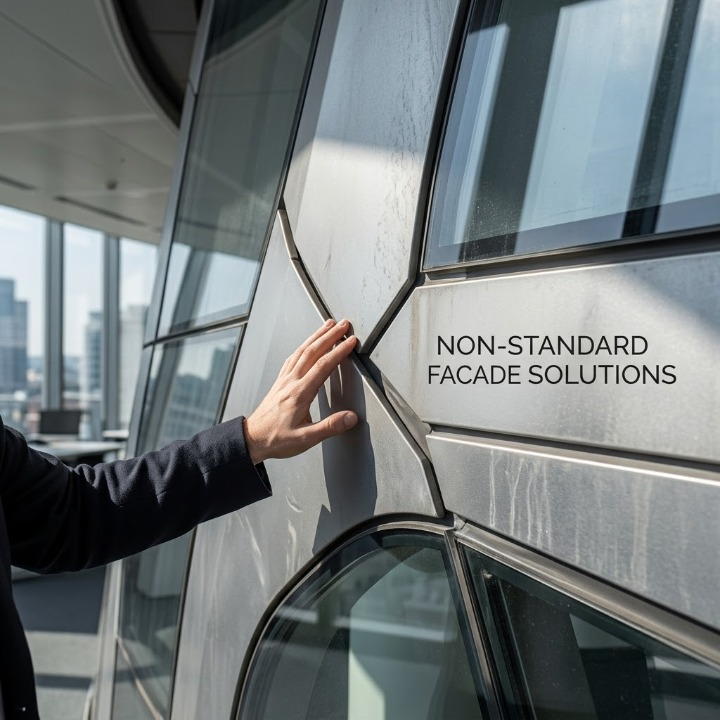
Applying standard repetitive panel logic to building envelopes with irregular transitions and discontinuities can produce a panelization scheme that does not actually fit the envelope’s real geometry.
Why Repetitive-Panel Logic Assumes Consistency
Standard facade panelization strategies often rely on repeating a limited set of panel types across a consistent envelope. This logic works well for envelopes with regular, repeating geometry — but breaks down where the envelope includes irregular transitions, discontinuities, or one-off geometric conditions that a repetitive strategy was never designed to accommodate.
Where the Mismatch Becomes Apparent
A facade engineer applying standard repetitive logic to an envelope with genuine irregularities may find that the panelization scheme technically covers the surface, but does so with panels that do not cleanly resolve at transition points — creating fabrication or installation complications at exactly the locations where the envelope departs from a simple repeating pattern.
Why This Requires a Distinct Strategy, Not a Workaround
Non-standard envelopes are not simply a more complex version of the same repetitive-panel problem — they require a genuinely different rationalization approach, one built to handle non-repetitive geometry directly rather than attempting to force irregular conditions into a repetitive framework.
A Computational Approach Built for Non-Repetitive Geometry
After explaining why non-standard envelopes require a distinct panelization strategy from repetitive facades, DASH’s facade engineering solutions offer the computational approach built to handle non-repetitive geometry directly.
Consult with DASH’s team about your non-standard envelope.