
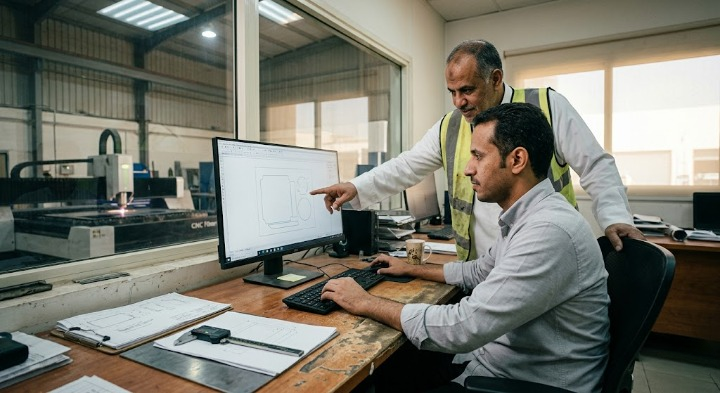
In the high-velocity manufacturing sectors of 2026, investing in an advanced CNC laser cutting machine is a definitive move to maximize operational margins.
However, the harsh reality for many fabrication facilities is that high-tier hardware frequently operates far below its maximum velocity. The bottleneck is rarely the machine’s physical acceleration; it is the “Data Feeding” process—specifically, slow file preparation, manual drafting fixes, and unoptimized engineering data.
When a CNC laser or router stands idle because the programming office is bogged down in manual file adjustment, the factory suffers a continuous financial hemorrhage in energy overhead and labor capital. To close this gap, enterprises must transition from manual desktop drafting to automated, production-ready data generation.
The Core Pillars of Downstream Fabricating Efficiency
A CNC machine is only as fast as the data it receives. According to modern digital production sustainability protocols, maximizing workshop throughput relies on three fundamental technical pillars:
- Software Automation: The upstream drafting mechanism that translates architectural parameters into clean, error-free geometry without manual human intervention.
- Material Logic: Synchronizing the unfolded flat-pattern dimensions with precise real-world material behaviors, such as thickness allowances and K-factor variables.
- Downstream Compatibility: Generating highly standardized digital files that allow the factory’s CAM (Computer-Aided Manufacturing) software to instantly compute optimal cutting paths without geometry errors or missing data.
Architectural Diagnosis: Eliminating Geometry Errata
Engineering research in sustainable manufacturing highlights that geometry optimization is the decisive factor in reducing shop-floor waste and energy spikes. In high-precision sheet metal and facade fabrication, any technical lag during file preparation directly impacts overall equipment effectiveness (OEE).
When design files contain overlapping lines, open loops, or unlinked external references, the factory’s CAM software struggles to calculate clean toolpaths. This forces machine operators to manually fix drawing errors at the workstation—a high-risk practice that stalls production. The true intelligence of a modern workflow does not reside in the physical steel frame of the laser; it lies in the upstream algorithm that ensures the initial output is pristine and ready for machine translation.
From Preparation Lag to Peak Performance Certainty
Manual file preparation is an operational liability that introduces heavy technical debt into your production line. Every minute an engineer spends manually tweaking a DXF file is a minute the fabrication floor stands unproductive.
Strategic Consultant Note
“Because every shop floor uses different machinery—ranging from high-power fiber lasers to specialized multi-axis routers—software should not attempt to dictate machine-specific code. True efficiency is achieved by delivering mathematically perfect geometry to the factory, allowing local CAM systems to generate tailored G-code instantly.”
CladCut: The Engine Behind Fabrication Velocity
CladCut serves as the specialized calculation engine for facade and cladding development. Instead of forcing engineers into tedious, manual spreadsheet calculations to generate a cutting list, CladCut automates the entire geometry creation process based on direct architectural inputs.
Rather than generating machine-specific G-code or acting as a direct machine interface, CladCut focuses entirely on outputting hyper-precise, standardized DXF files. Because every CNC machine model requires distinct parameters, feeds, speeds, and post-processors, CladCut delivers clean, uncorrupted vector data that factory programmers can seamlessly convert into machine-specific code.
By eliminating drafting bureaucracy and ensuring 100% accurate flat-pattern outputs, CladCut reduces file preparation time by up to 80%, keeping the factory’s CAM pipeline continuously supplied.
Engineered FAQ
Does CladCut export G-code directly to the laser cutting machine?
No. CladCut is not a nesting software and does not export G-code or interface directly with CNC machinery. It outputs clean, mathematically accurate DXF files. Because every CNC machine is different, the translation from DXF to machine-specific G-code is handled natively by the factory’s localized CAM software.
How does automating the cutting list improve workshop efficiency if it doesn’t control the machine?
Machine downtime is heavily driven by operators trying to interpret ambiguous drawings or fixing broken vector paths. By automating the cutting list and exporting standardized DXF geometry, CladCut eliminates human drafting errors, ensuring the factory’s software can generate optimal cutting paths on the first attempt without processing stalls.
What is the specific benefit of specialized facade software over generic CAD tools?
Generic software lacks engineering logic for specialized materials like Aluminum Composite Panels (ACP) or solid cladding. CladCut automatically factors in precise folding dimensions, bend allowances, and fixation points directly into the exported DXF layout, ensuring the physical output matches the architectural blueprint with millimeter precision.