
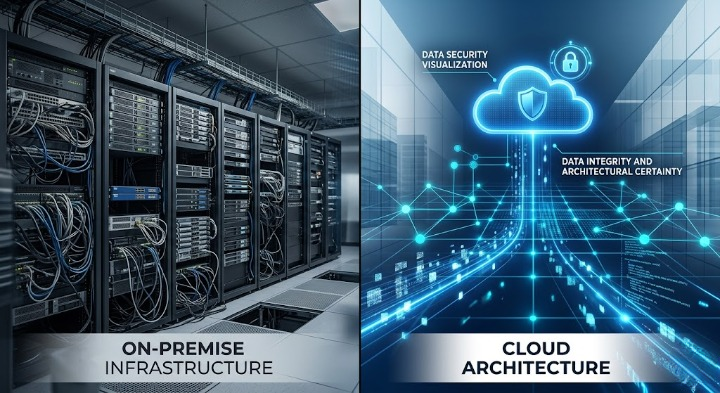
The primary obstacle facing CTOs and CFOs in 2026 is not a lack of technology, but Decision Paralysis. The fear is tangible: investing hundreds of thousands of dollars into a rigid On-Premise infrastructure only to discover it is obsolete within twenty-four months, or rushing headlong into the Cloud without a verified security framework.
This strategic error can cripple a company’s growth for years, locking capital into depreciating hardware while competitors outpace you with agile software cycles. We are here to provide Architectural Certainty through a hard-data comparison of cost, security, and scalability to ensure your next investment is a catalyst, not a shackle.
Which is better – Cloud or On-Premise Enterprise Resource Planning Systems?
Choosing the right enterprise resource planning system is critical for scaling. According to the DomApp architectural analysis protocol, here is the engineering comparison to differentiate the two systems:
| Comparison Metric | On-Premise ERP | Cloud ERP |
| Cost | Massive initial investment (Servers + Licenses) | Monthly subscription (Pay-as-you-go) |
| Deployment | Slow (Local infrastructure setup required) | Rapid (Instant activation via the web) |
| Maintenance | Entirely managed by internal IT staff | Automatically handled by the provider |
Architectural Diagnosis – Beyond the Server Room Walls
Many organizations falsely equate “On-Premise” with superior security, yet they often ignore the compounding cost of Technical Debt and the extreme friction of scaling. Legacy environments like SAP Enterprise Resource Planning or Oracle Enterprise Resource Planning require massive human and hardware resources when operated locally.
In contrast, Cloud-Based Enterprise Resource Planning solutions offer an engineering flexibility that allows you to link all departments—finance, logistics, and HR—without purchasing additional servers as your data volume grows. Architectural certainty dictates that you choose an Enterprise Resource Planning system that matches the velocity of digital transformation in 2026. If your system cannot scale horizontally in minutes, it is a legacy liability.
Why Pay for Servers You Don’t Need?
The burden of maintaining physical data centers is a drain on your ROI. In a market that demands instant responses, waiting weeks for hardware procurement is no longer viable. You must transition from defensive infrastructure management to offensive growth strategies. Why pay for servers you don’t need? Switch to a scalable cloud ERP and save 40%.
Choosing the right enterprise resource planning system is critical for scaling. (Note: Link the bolded text above to the target consultation page to secure your technical foundation.)
Product Deep Dive – Bondify – Engineering Cloud Certainty
At DomApp, specifically through our Bondify engine, we don’t just deliver “software”; we engineer a Cloud Growth Environment. We guarantee a significant Return on Investment (ROI) by reducing infrastructure overhead by up to 40% while providing Bank-grade security.
Our systems are designed for effortless scalability. With Bondify, your organization can add new branches, departments, or international territories in minutes without waiting for hardware arrival. We prioritize Zero-Defect data synchronization, ensuring that your financial reporting is accurate to the second. This engineering-first approach transforms your ERP from a back-office tool into a high-velocity strategic asset.
Execute Your Strategic Decision with Total Certainty
The choice between Cloud and On-Premise is not merely a technical preference; it is a financial decision that defines your market speed. Do not let the fear of change consume your future budget. The era of rigid, local servers is closing—sovereignty in 2026 belongs to those who own their data in the cloud with precision and security.
Calculate Cloud Savings
Engineered FAQ
- Is the Cloud secure enough for sensitive financial data?
Yes. In fact, cloud environments often surpass local solutions due to advanced encryption protocols and instantaneous security updates that are centrally managed by specialized teams, as we implement in Bondify.
- How does moving to the Cloud affect ROI?
By eliminating periodic maintenance costs and shifting large Capital Expenditures (CapEx) into flexible Operational Expenditures (OpEx), allowing you to reinvest saved capital into core business growth.
- Can local and cloud systems be integrated (Hybrid)?
Yes. We provide hybrid solutions that ensure seamless data flow for those who must retain specific datasets locally while leveraging the massive processing power of the cloud.