
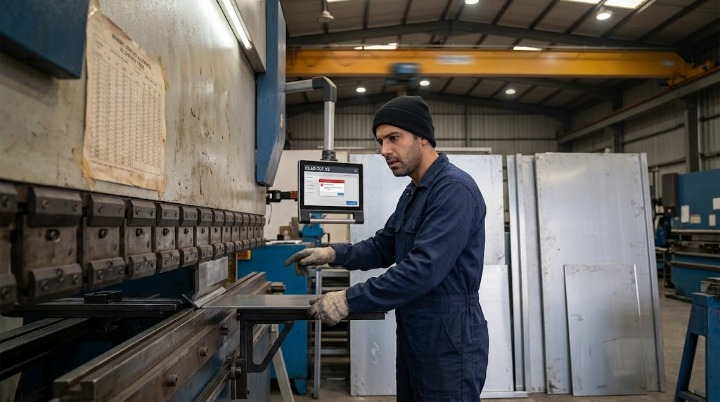
Fabrication engineers referencing generic bending allowance charts may be unaware that these values introduce errors for modern ACP compositions with different core materials and tempers.
Why a Generic Table Cannot Reflect Every Material Variation
A bending allowance table represents a fixed set of values calculated for specific assumed material properties. Real aluminum composite panels vary by alloy, temper condition, core material, and even batch-to-batch material variation — meaning a single generic table can only be accurate for the specific combination it was originally calculated for, and increasingly inaccurate for any composition that diverges from that original assumption.
Where Reliance on Generic Tables Persists
Fabrication shops that have relied on the same reference table for years, particularly one inherited from earlier practice or printed and posted near the brake press, may continue using it even as the actual ACP compositions being processed have evolved to include different core materials the original table was never calibrated for.
Why This Produces Errors That Feel Inexplicable
Because the table itself has not visibly changed and has “always worked before,” errors introduced by using it on a material composition it was not calibrated for can feel confusing or inexplicable to the fabrication team — when the actual explanation is straightforward: the table’s assumptions no longer match the material actually being processed.
Computing Unique Allowances Based on Specific Material Properties
After demonstrating why generic tables fail to capture alloy, core, and temper variation, the fix is calculating bending allowance individually for each panel’s actual material properties, rather than relying on a static reference table. Clad Cut V2’s per-panel bending calculation engine computes unique allowances based on each panel’s specific material properties, replacing generic table lookup with calculation genuinely matched to the material being processed.
Validate your bending method — Audit Clad Cut V2’s per-panel calculator.