
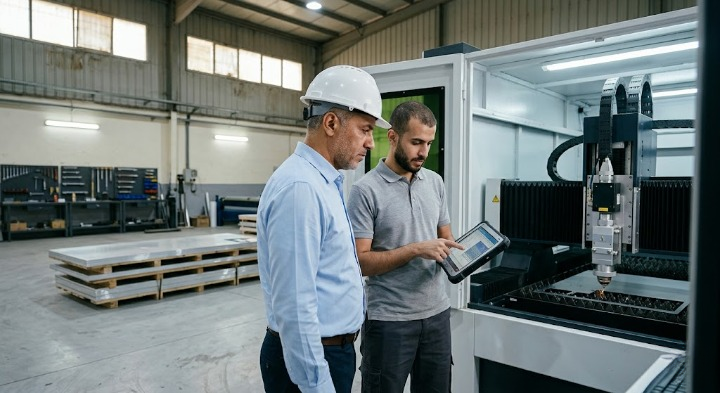
Investing upwards of $50,000 in a CNC laser cutter is a strategic pivot that can either propel your factory to the top of the market or drown it in endless technical debt. The real anxiety—Decision Paralysis—stems from the fear of purchasing a machine that is incompatible with required aluminum thicknesses or fails to handle the intricate complexities of modern facade designs.
Buying the “wrong technology” doesn’t just mean losing the machine’s price tag; it means losing massive contracts due to sluggish production or substandard cutting precision. This 2026 buyer’s guide is engineered to help you choose the technical and software specifications that guarantee the highest Return on Investment (ROI).
Quick Specs Comparison for Facade CNC Laser Cutters
Before buying hardware, ensure you have the right facade optimization tool to manage your files. According to DomApp’s technical auditing protocol, these are the critical specs to verify when inspecting any CNC laser cutter for sale intended for facades:
- Laser Source: Fiber Laser is the engineering standard for metals (Aluminum, Steel). Capacity should not be less than 3KW.
- Bed Size: Must be at least 4000×2000 mm to accommodate standard cladding panels without unnecessary waste.
- Cutting Speed: Look for a travel speed of at least 100 m/min to ensure high-velocity production efficiency.
- Compatibility: Seamless support for G-Code files generated by automated engineering software.
- Cooling System: A dedicated Industrial Chiller is mandatory to ensure operational continuity in high-temperature environments.
Engineering Diagnosis: The Language of Metals — Fiber vs. CO2
In the world of facade fabrication, the distinction between laser types is not a preference; it is a structural necessity. Many startups looking for the best CNC laser cutter for small business fall into the trap of purchasing a CO2 CNC laser cutter, assuming it will suffice for aluminum. In reality, CO2 lasers are architected for non-metals. For aluminum cladding, Fiber technology is the only path to millimeter precision.
To ensure a profitable production cycle, one must consider a profitable mixed CNC laser cutter only if the factory handles a diverse range of materials. As facade engineering experts, we assert that while seeking “CNC laser cutting services near me” is a temporary fix, market sovereignty belongs to those who own the hardware and the Technical Certainty to run it under constant pressure without failure.
The Golden Bridge: Hardware is the Body, Software is the Brain
The most advanced laser cutter on the market is merely a pile of high-tech steel without the right intelligence to drive it. The bottleneck in modern factories is rarely the machine’s speed, but the speed of file preparation.
“No matter which cutter you buy, it needs the right brain to run it efficiently.”
Before buying hardware, ensure you have the right facade optimization tool to manage your files. (Publisher Note: The anchor text above should be linked to the CladCut technical consultation page.)
Product Deep Dive: CladCut – The Mastermind of Your Laser Machine
CladCut acts as the high-precision “brain” for your CNC hardware. We do not sell machines; we sell the Algorithmic Intelligence that moves them. As a dedicated facade optimization tool, CladCut transforms complex architectural blueprints into “smart” cutting paths.
By utilizing our automated G-Code generation, CladCut reduces material waste by 20% and significantly increases the feed speed of your production line. Your ROI is realized the moment you see your $50,000 investment running at 100% actual capacity, free from the errors of manual file preparation and human typos.
The Grand Finale: Invest in Certainty, Not Guesswork
Purchasing the laser hardware is only half the battle; the other half is how you manage that laser. Do not allow your massive investment to be held hostage by slow manual processes and costly human errors. Transition from defensive manual planning to offensive automated execution.
Check Software Compatibility (Would you like me to analyze your specific machine’s G-Code requirements to ensure it can handle 2026’s architectural demands?)
Engineered FAQ
- Is Fiber Laser truly better than CO2 for cladding facades?
Absolutely. Fiber Laser is the engineering benchmark for cutting aluminum and metals. It provides superior speed and edge quality that legacy CO2 technology simply cannot replicate.
- What is the importance of a facade optimization tool before buying a machine?
The software determines how much of the machine’s bed you actually utilize. Without an optimization tool like CladCut, even the most expensive hardware will operate at a low efficiency, leading to excessive scrap.
- How can I ensure the machine achieves a fast ROI?
By ensuring it runs for longer hours with minimal downtime. Automated file preparation and reducing “idle time” caused by manual G-Code errors are the fastest ways to reclaim your investment.