
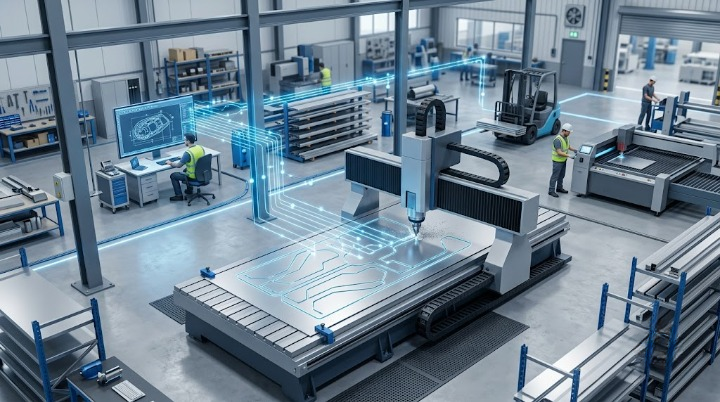
Relying on low-tier, unverified local workshops for premium building envelopes is an immediate operational liability. In the commercial construction sector, sub-standard production compromises architectural intent, delivering a defect that triggers immediate consultant rejections. This manufacturing failure manifests as a severe visual and structural crisis: receiving poor quality, wavy panels from local fabrication shops with low standards. This visible deformation compromises the project’s external flat surface and introduces long-term oil-canning vulnerabilities under mechanical loads. To pass municipal audits, enforce strict structural safety, and maintain complete compliance, adopting certified cladding quality standards is a strict financial and structural requirement.
In this engineering manual, we diagnose the technical errors that occur within uncertified workshops and demonstrate how transitioning your workshop to an automated, code-compliant digital workflow secures absolute manufacturing precision.
How to identify certified aluminum fabrication near me for high-end projects?
According to the quality control protocols within the CladCut platform for automated engineering parameters, a local aluminum fabrication shop must satisfy three strict manufacturing criteria to achieve certified status:
- Fabrication Compliance: Processing CAD drawings through parametric computing systems that calculate exact edge fold deductions automatically, eliminating manual data conversion errors.
- Workmanship Quality: Executing V-grooving paths with sub-millimeter precision, leaving exactly 0.3mm of the mineral core intact to protect the outer aluminum skin from folding stress fractures.
- Localized Engineering: Verifying that all panel sizing, gap widths, and fastening configurations are mechanically engineered to withstand the mandatory wind speed parameters of the Saudi Building Code (SBC).
The Technical Diagnosis – Dissecting Fabrication Compliance and Site Installation Risks
In high-performance facade execution, structural flatness is determined entirely on the workshop floor. Uncertified facilities fail because they approach production through non-systemic manual metrics. When a workshop relies on hand-calculated cutting lists, small human measurement errors accumulate across the facade grid. These deviations compromise the overall fabrication compliance, causing dimensional discrepancies that ruin the subsequent site installation.
Furthermore, maintaining structural integrity under cyclical thermal loads requires a strict understanding of localized engineering. When certified fabricators execute panel sizing, they calculate the exact physical expansion coefficient of the metal skin. Uncertified local shops ignore these thermodynamic realities.
If the routing depth cuts too deep into the sheet, the structural core is compromised, causing the aluminum face to buckle under seasonal temperature deltas. This structural deficit degrades workmanship quality and leads to progressive panel wrinkling, stripping the building envelope of its luxury aesthetic and structural safety.
The Geometric Pivot – Elevating Local Workshops to Algorithmic Certainty
Eliminating the risk of wavy panel deliveries and continuous client rejections cannot be achieved through on-site adjustments. Trying to fix dimensional errors during field installation introduces uncoordinated human variables that destroy project schedules and blow past cost boundaries. True manufacturing precision requires resolving your geometric calculations at the file level before a single router bit touches the raw stock.
To upgrade your facility’s reputation from a conventional local supplier to a certified engineering operation, you must implement automated data integration. Standardizing your layout maps through verified software platforms guarantees that every finished cassette satisfies strict structural tolerances automatically. Transitioning your workshop to a unified digital workflow allows you to minimize material waste while securing the continuous quality optimization of your [aluminum fabrication shop] across all complex commercial tenders.
Product Deep Dive – How CladCut Eliminates Operational Errors in Local Facilities
The DomApp CladCut platform provides the advanced automation infrastructure required to eliminate manual execution risks from your manufacturing data, replacing human estimation with absolute physical math.
- Algorithmic Nesting ROI: By executing advanced 2D bin-packing configurations, CladCut computes thousands of pattern possibilities to decrease high-value material waste (Scrap) to under 8%, saving up to 80% of manual engineering review hours.
- Automated Grain Direction Lock: The engine programmatically locks sheet orientations across metallic and brushed finishes, completely preventing the visual shading anomalies that ruin exterior facades.
- Precision Toolpath Generation: Generates zero-error G-code directly for your CNC machinery, controlling variable feed rates and cutting speeds to ensure smooth edge finishes and perfect fold parameters on every run.
This computational synchronization ensures that every single component delivered to the site satisfies your engineered parameters, guaranteeing certified compliance and seamless installation from the first run.
Certified Standards Protect Material Yield and Factory Profits
In the competitive architectural cladding sector, commercial success is determined by manufacturing accuracy and operational efficiency. Time lost to manual calculation mistakes or replacing warped sheets represents a total loss of your net profit margins. Securing your professional reputation and passing rigid consultant audits requires moving away from traditional, isolated workshop workflows toward high-yield fabrication automation. Protect your factory margins and ensure absolute code compliance through data automation.
Stop leaving your production accuracy to manual guesswork. [Download Fabrication Checklist] today to see how DomApp establishes technical certainty across your entire manufacturing facility.
Engineered FAQ
Do DomApp systems guarantee factory compliance with Saudi Building Code (SBC) load standards?
Yes. All structural parameters and tolerance configurations generated across our unified platform align directly with the wind load and safety metrics mandated by the SBC, ensuring absolute regional compliance.
How does the software prevent tool scratching and coating damage during CNC routing?
CladCut regulates precise toolpath parameters and entry vectors (Lead-in/Lead-out limits). This prevents the router bit from scuffing the finished PVDF layer, maintaining factory coating warranties.
Does optimizing sheet utilization require separate software applications?
No. CladCut contains an integrated, high-performance mathematical nesting engine built specifically for aluminum composite materials, while primary environmental wind force loading calculations are processed in our structural module, Wind Master.