
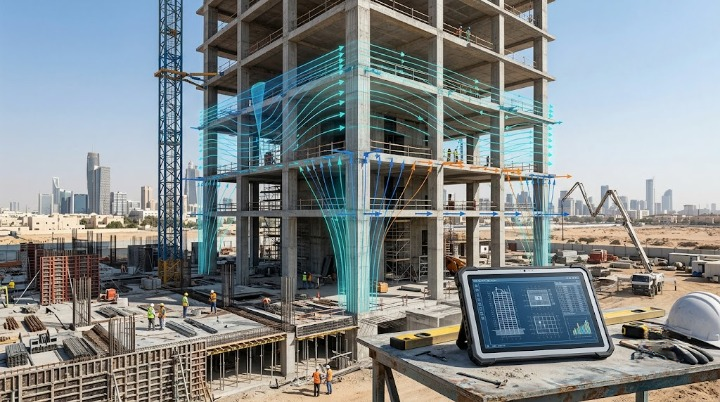
The headache of reconciling office-calculated loads with actual site conditions and strict inspection standards is a silent operational drain on modern projects. Structural consultants routinely watch construction timelines stall when field inspectors flag variations between pre-approved theoretical documentation and real-world asymmetric exposures. If you are responsible for validating calculations on active zones, relying on generic lookup sheets or unverified assumptions for calculating wind load on a structure introduces critical structural vulnerabilities. This field guide provides an exact methodology to replace manual field discrepancies with verified, audit-ready data generated directly on the spot.
What is Tributary Area in Calculating Wind Loads on Structures?
According to the Wind Master structural lookup logic, the Tributary Area for wind loading is defined as:
Tributary Area is the specific surface area loading boundary directly supporting an individual structural element, cladding cassette, or fastener anchorage, transferring calculated wind pressure forces directly to the primary framework.
To establish consultant-ready accuracy when calculating wind load on a structure, site teams must execute a strict compliance check following this target structure:
- Building Geometry Data: Validate the actual executed structural heights, width ratios, and real-world grid alignments manually before extracting pressure coefficients.
- Parapet Wind Load Parameters: Isolate the combined net pressure coefficients acting simultaneously on both the windward and leeward faces of exposed structural trim.
- Roof Overhang Pressure Matrices: Apply localized upward suction multipliers to account for pocketed air pressure accumulation under external horizontal ceiling elements.
Diagnostic Breakdown – Mapping Net Forces and Structural Surface Interactions
Achieving absolute technical precision during a field audit requires tracing how atmospheric variables turn into clear, numerical forces. As a site engineer, your constructability review must accurately isolate how spatial constraints alter the global structural surface interaction.
- Tributary Area Analysis: Pressure values (kN/m2) must be integrated across exact structural boundaries to determine the actual net force transferred into individual anchors.
- Aerodynamic Exposure Multipliers: Velocity profiles cannot be assumed uniform across a facade plane; edge elements experience severe separation and accelerated local suction loads.
- Enclosure Classification Security: Unplanned field modifications to fenestrations can alter internal pressure values, instantly shifting a structure’s design metrics from enclosed to partially enclosed.

Transitioning from Field Chaos to Code-Verified Certainty
The frustration of managing manual data gaps and unverified site math is entirely optional. Moving toward a locked computational system is the only reliable path to protect your professional standing and guarantee safety-critical compliance. Wind Master bridges this tracking gap by acting as a native, code-locked lookup environment where raw geometric configurations are instantly processed into audited compliance logs.
To protect your field assets against unexpected rejections, you can automate your calculating wind load on a structure pipeline by migrating away from unverified templates and deploying our locked cloud infrastructure.
Product Deep Dive – Wind Master Field Optimization
Wind Master is a web-based extraction tool optimized to deliver absolute technical certainty for engineers operating under strict municipal audit conditions. It completely eliminates formula corruption variables while preserving calculation speed.
- SBC 301 Mechanical Backend: The calculation framework runs exclusively on compiled, hard-coded codebook equations, removing formula manipulation risks.
- 15-Minute Field Sprint: Input manual field measurements directly into the platform to generate a comprehensive numerical submittal package in under 15 minutes.
- Consultant-Ready Reporting: Outputs formal numerical PDF report packets displaying all geometric justifications, allowing inspector sign-off on the first attempt.
- On-Demand Quota Architecture: Access professional math tracking dynamically via an agile report quota system, backed by watermarked trial access for system validation.
Enforce Precision Across Your Job Site
Vague data entry and spreadsheet drift compromise site safety, leaving your project vulnerable to structural liabilities and permit stagnation. Stop gambling with unverified math and manual lookup processes. Lock your safety boundaries and secure immediate consultant sign-off by standardizing your pressure calculation flow today.
Protect your structural submittals against municipal audit friction. [Register for a Free Account] on Wind Master now and access zero-error structural validation variables instantly.
Engineered FAQ (Field Wind Principles)
- Does Wind Master automate structural section layout or steel member design?
No. Wind Master functions strictly as a load extraction module to isolate net forces and wind pressures. Element optimization and structural section sizing remain the engineer’s task within their chosen engineering design suite.
- Are the pre-programmed wind velocity tables aligned with MOMRA mandates?
Yes. Every calculations report references the exact regional 3-second gust wind matrices and topographic lookups enforced across Saudi municipal jurisdictions.
- Can I import digital point-cloud surveys directly into the lookup engine?
No. To maintain complete computational validation and enforce rigorous manual error prevention, all dimensions and local parameters must be input directly through the locked interface.