
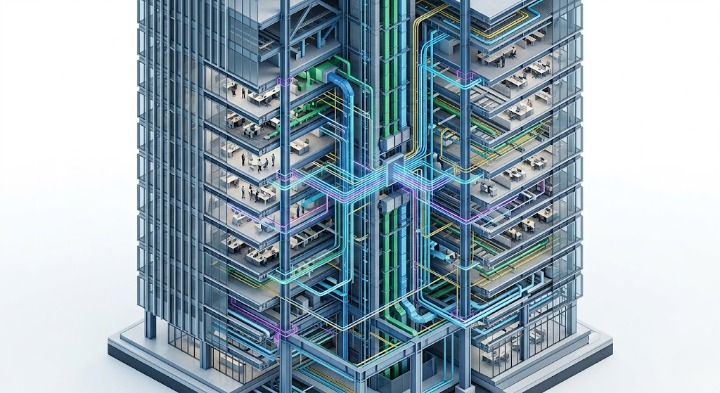
Data silos and outdated models are the primary catalysts for project failure in the construction sector. When engineering teams work in isolation, the discovery of intersecting MEP pipes and structural beams usually
happens on-site, leading to immediate chaos and aggressive finger-pointing among contractors. This lack of BIM coordination is not just a technical oversight; it is a financial drain that results in repetitive site rework and lost project margins. In this technical guide, we examine how transitioning to a unified digital environment ensures that resolving the majority of critical coordination issues before construction begins.
What is the BIM Coordination Process?
BIM coordination is a technical workflow designed to merge 3D models from various disciplines—architectural, structural, and MEP—into a single, intelligent environment to resolve spatial conflicts. According to DASH’s protocol for parametric BIM coordination workflows, the process follows this rigid sequence to improve coordination accuracy :
- Model Integration: Consolidating all disciplinary models into a “Digital Twin” to establish a Common Data Environment (CDE).
- Clash Detection: Utilizing automated interference checking (e.g., Navisworks) to identify physical and clearance-based intersections.
- Spatial Coordination: Algorithmic distribution of system paths and elevations to optimize building envelope efficiency.
- Issue Resolution: Executing programmatic model adjustments to ensure absolute precision and constructability compliance.
Technical Diagnosis: Resolving the Integration Gap in 3D BIM Services
Effective multidisciplinary integration requires moving beyond static models that fail to respond to real-time changes. Most projects suffer from “Dead Models” where spatial coordination becomes a time-consuming administrative burden rather than a risk-management tool. A professional constructability review must utilize Virtual Design and Construction (VDC) principles to turn modeling into an active defense against budget overruns.
Through advanced Navisworks modeling, we don’t just find hard clashes; we engineer solutions for MEP BIM coordination that respect maintenance clearances and Saudi Building Code (SBC) standards. By resolving spatial conflicts in the pre-construction phase, you eliminate the operational friction that typically delays high-density industrial and commercial projects.
From Site Conflict to a Single Source of Truth
The transition from manual drafting and siloed systems to a centralized coordination engine is the exact point where profitability is secured. Imagine shifting from a site environment where contractors argue over pipe routes to a streamlined workflow where the model acts as the “Single Source of Truth.” By integrating [إشارة للناشر: تم دمج نص الرابط في الجملة التالية. يرجى تفعيل الرابط التشعبي على الكلمات التالية: “parametric BIM coordination workflows” وتوجيهها للرابط الهدف.] parametric BIM coordination workflows, DASH unifies architectural, structural, and MEP disciplines into one intelligent model, turning site-level chaos into a harmonized engineering symphony.
DASH – The Engine for High-Performance BIM Integration
DASH is not a drafting agency; it is your technical partner in Virtual Design and Construction (VDC). We provide an immediate Return on Investment (ROI) by applying proprietary extraction algorithms to your models:
- Scrap Reduction: Resolving clashes digitally prevents the procurement of incorrect materials for site-level modifications.
- Engineering Automation: Rapidly updating as-built documentation based on real-time site adjustments.
- Financial Certainty: significantly reducing site rework, which typically consumes up to 20% of a project’s total budget.
Precision Compliance – Secure Your Execution Strategy
In Tier-1 construction, time is capital. Relying on fragmented teams and outdated documentation is a conscious choice to bleed profits. Automated BIM coordination is a critical tool for reducing clashes and improving schedule reliability.
[Partner with DASH for expert BIM Coordination on your next project] and end the cycle of costly site rework today.
Engineered FAQ
- Does DASH support coordination for complex MEP systems?
Yes. We specialize in high-density MEP BIM coordination for high-rise and industrial projects, helping optimize mechanical and electrical routing.
- How does DASH accelerate clash resolution?
By using parametric BIM coordination workflows, we programmatically adjust system routes to bypass obstructions, significantly reducing the time spent in manual engineering meetings.
- Are the outputs compliant with local standards?
Absolutely. Every model integration is verified against the Saudi Building Code (SBC) and local municipal requirements to support constructability review and regulatory compliance