
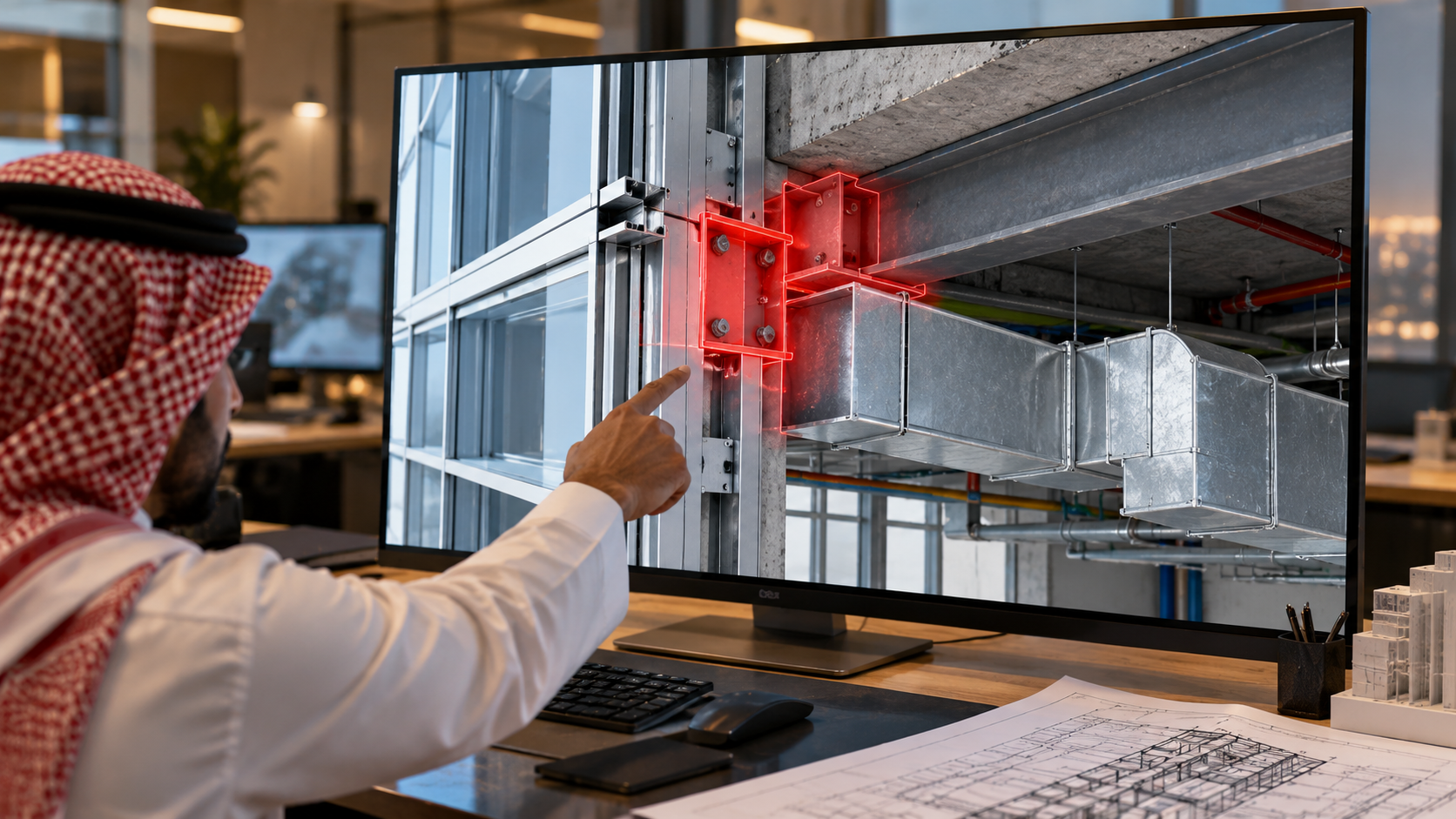
A facade bracket, fully detailed on paper, gets sent for fabrication — and only on site does anyone discover it physically collides with a structural beam that was never checked against it. The panel is remade, the schedule slips, and the installation crew stands idle waiting on a fix that clash detection would have caught weeks earlier, on a screen, before a single bolt was cut.
This guide explains what BIM clash detection actually catches for facade systems, the specific conflict types that recur most often, and how modeling detail level determines whether these clashes are found before construction or after.
What Is BIM Clash Detection for Facade Systems?
BIM clash detection is the process of checking a facade model against structural and MEP models to identify physical conflicts — such as a bracket overlapping a beam or a duct routed through a fixing zone — before construction begins, preventing costly on-site rework.
The Engineering Diagnosis
The clashes that most commonly affect facade systems fall into a small set of recurring patterns: a bracket or fixing point that overlaps a structural beam or column, a fastener path that intersects an MEP duct or pipe run routed through the same ceiling or wall void, and anchor points positioned without checking clearance against reinforcement or embedded conduit. None of these are exotic conditions — they are the kind of conflict that occurs whenever facade elements are designed on one track and structural or MEP systems are designed on another, without a coordinated check between the two.
The reason these clashes go undetected until site is straightforward: a facade element that hasn’t been modeled with real geometry — a bracket represented as a generic block instead of its actual bolt pattern and depth, for instance — cannot be meaningfully checked against a beam or duct model. The clash exists physically, but it is invisible in a coordination review that is only looking at simplified placeholder geometry.
From Diagnosis to Certainty
This is exactly why clash detection is only as reliable as the detail level of the model feeding it. A facade model built to a generic or approximate level of development can pass a coordination review cleanly and still contain unresolved physical conflicts, simply because the elements most likely to clash were never modeled in enough detail to be checked.
How DOME FDH Catches These Clashes Before They Reach Site
DOME FDH’s BIM Services model facade brackets, bolts, and fixing hardware to LOD 400 by default — the detail level that makes a bracket-versus-beam or bracket-versus-duct clash something a coordination review can actually catch on screen, rather than a conflict discovered only once installation crews reach that point on the building.
This means clash detection against structural and MEP models is a meaningful technical check on every DOME FDH facade project, not a formality performed on an under-modeled facade that was never detailed enough to reveal where the real conflicts sit.
The Grand Finale
A clash caught in a coordination model costs a design adjustment. The same clash caught on site costs remade panels, idle installation crews, and a schedule that has to absorb an unplanned delay. The difference between the two comes down entirely to whether the facade model was detailed enough to make the clash visible before construction started.
Ask About BIM Clash Detection Services and find out whether your facade model is detailed enough to catch real conflicts before they reach site.
Engineered FAQ
What kinds of clashes are most common between facades and other building systems?
Bracket or fixing point conflicts with structural beams and columns, and fastener paths intersecting MEP ducts or pipe runs, are among the most frequent facade-specific clash types.
Can clash detection be performed on any BIM model, regardless of detail level?
Not meaningfully. A model without real bracket, bolt, and fixing geometry cannot be reliably checked against structural or MEP systems for physical conflicts.
Does DOME FDH model facades to a detail level that supports real clash detection?
Yes, DOME FDH’s BIM Services model to LOD 400 by default, including bolts and brackets, specifically to support clash checking against structural and MEP system .