
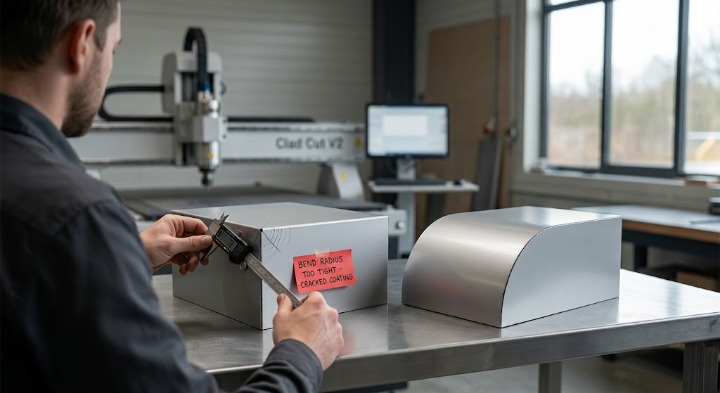
Fabricators bending ACP cassettes at tight radii that look acceptable at production can develop hairline coating cracks visible as corrosion streaks on the building facade, triggering warranty claims.
Why Bend Radius Ratios Are Not Arbitrary Guidelines
Every ACP alloy and thickness combination has a minimum safe bend radius-to-thickness ratio, below which the material’s surface coating experiences stress beyond what it can safely withstand — producing micro-cracking that is not visible immediately but becomes apparent as corrosion over time as moisture penetrates the compromised coating.
Where This Failure Mode Goes Undetected at Production
Micro-cracking from an overly tight bend radius does not typically appear as a visible defect at the point of fabrication — the panel looks correctly formed. The problem only becomes visible months later, once the coating’s compromised integrity allows corrosion to develop, by which point the panel is already installed on the building.
Why This Timing Makes the Failure Especially Costly
A defect discovered at production can be corrected before installation. The same defect, discovered as visible corrosion on an installed facade, requires removal and replacement of already-installed panels — a far more expensive and disruptive correction than catching the issue before the panel ever left the shop.
Flagging Panel Designs That Exceed Safe Bending Limits Before Cutting
After presenting the minimum bend radius ratios by alloy and thickness, the fix is validating bend parameters against these minimums before cutting, rather than discovering a violation only once corrosion appears months or years later. Clad Cut V2’s built-in bend parameter validation flags any panel design exceeding safe bending limits before it reaches the CNC machine, catching the risk at the only point where correction is genuinely low-cost.
Validate your bend radius ratios — Audit Clad Cut V2 before cutting.