
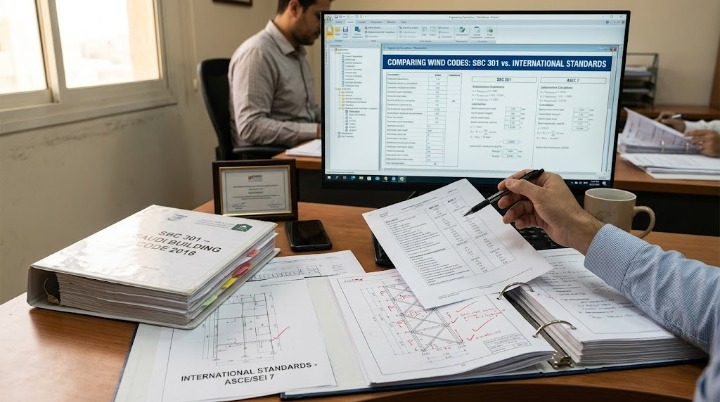
Applying familiar international wind code provisions directly to a Saudi project, without adjusting for SBC 301-specific requirements, produces a report that fails local compliance review despite the underlying engineering experience being genuinely sound.
Why Familiarity With One Code Does Not Transfer Automatically
Engineers trained extensively on international wind codes bring real technical competence to a Saudi project — but competence with one code framework does not guarantee that provisions transfer directly to another. SBC 301 incorporates ASCE 7-16 with specific local adaptations, and the points where it diverges from commonly referenced international standards are exactly where an experienced engineer’s instincts, calibrated on a different code, can lead them astray.
Where Misapplication Happens
An engineer accustomed to a different code’s wind speed maps, risk category definitions, or exposure classifications may apply those familiar frameworks to a Saudi project without specifically verifying where SBC 301’s local incorporation diverges from the international baseline. Because the resulting calculation follows a logically consistent method — just not the locally correct one — it does not look obviously wrong to the engineer who produced it.
Why This Surfaces During Review, Not Before
A calculation built on a subtly incorrect code framework can pass every internal check the originating engineer performs, since their internal consistency check is against the framework they know, not the one that actually governs the project. The gap only becomes visible when a municipality reviewer, working from the actual applicable code, identifies where the submitted calculation diverges from SBC 301’s specific requirements.
Applying Jurisdiction-Specific Provisions Automatically
After mapping the specific points where SBC 301 diverges from commonly referenced international codes, the fix is anchoring every calculation to the correct jurisdiction’s provisions by default, rather than relying on an individual engineer’s cross-code translation. Wind Master applies the correct jurisdiction-specific provisions automatically, ensuring an engineer’s international experience is supported by a calculation engine calibrated specifically to SBC 301 rather than left to manual translation.
Validate your code application — Audit for SBC 301-specific requirements.