
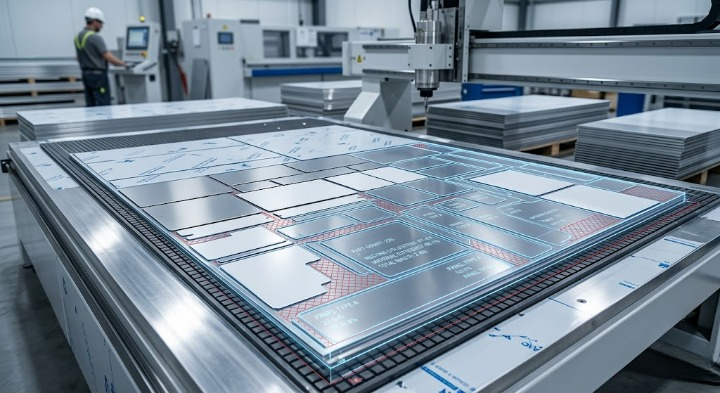
Optimizing Alco Panels can increase yield by 15% by effectively utilizing every square millimeter of the aluminum composite material. For most projects, standard sheets measuring 1220mm x 2440mm (8×4 feet) or 1250mm x 3000mm are the starting point. However, simply dividing the total facade area by these standard dimensions and adding a 10% buffer for cut-offs is no longer enough to stay competitive.
| Sheet Type | Standard Dimensions (mm) | Typical Usage |
| Small Format | 1220 x 2440 | Signage and interiors |
| Medium Format | 1250 x 3000 | Low-rise commercial projects |
| Large Format | 1500 x 4000 | High-rise buildings; minimizes seams |
| Custom Cut | Up to 15 feet wide | Specialized, uninterrupted facades |
The “6 vs. 7” Comparison: Why Nesting Matters
Imagine your layout requires several specific panel sizes. Using a traditional grid approach, you might only squeeze 6 panels out of a standard 1220mm x 2440mm sheet. By applying advanced nesting algorithms, you can rotate, offset, and interlock those same panel shapes to fit 7 panels on that exact same sheet.
That extra panel is pure margin. Claim it with advanced nesting algorithms that consider the following technical variables:
- Thermal Expansion Gaps: Accounting for the necessary 3mm to 6mm gaps required to prevent buckling and warping.
- Grain Direction: Ensuring all panels are cut in a consistent orientation to maintain visual continuity in the finish.
- Custom Fabrication: Leveraging the ability to order tailored solutions for unusual installation spaces to reduce on-site waste.
Maximizing Yield Through Digital Solutions
Advanced nesting algorithms can squeeze out 15% more parts from Alco panels by simulating thousands of layout combinations in seconds. This digital approach eliminates the human error associated with manual “best-fit” guessing, which often leads to disjointed seams or unpleasant gaps.
Whether you are working with 3mm sheets for interiors or 6mm robust panels for high-rise skyscrapers, sheet optimization ensures you use every square inch of your inventory.
Run a Comparative Test
Stop guessing your material needs. Use our Stock Calculator Tool to see exactly how much you can save on your next procurement cycle.
[Try the Stock Calculator]
Insights on Your Current Operation
To address your question: Usually, it’s a cascading problem. Most site managers start by obsessing over visible joints to satisfy the architect’s aesthetic vision, but they end up drowning in a high volume of offcuts because the manual “best-fit” approach ignores the underlying math of the sheet.
When you prioritize joint continuity without an optimization engine, you’re essentially forcing the material into a layout it wasn’t meant for, which turns your scrap bin into a “money pit.” A digital “nesting-first” strategy solves both: it provides the Zero-Defect visual flow for the joints while ensuring the material is used with millimeter precision.
Are you finding that your current “buffer” is consistently exceeding that 10% mark once you factor in the complex geometries of modern designs?