
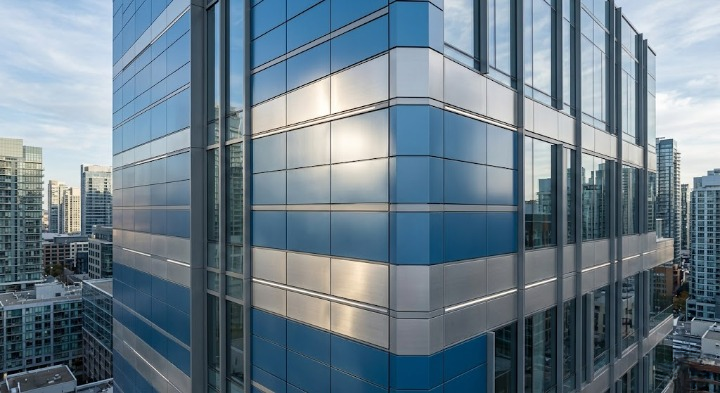
In the 2026 architectural facade industry, selecting the dimensions of Aluminum Composite Panels (ACP) is no longer a mere aesthetic preference; it is a critical engineering decision that directly impacts Return on Investment (ROI) .
Choosing the correct size is a precise balance between operational execution speed and minimizing facade , while ensuring the highest level of Technical Certainty.
Standard Sizes Matrix and Utilization Efficiency
ACP panels are available in engineering thicknesses ranging from 3 mm to 6 mm. The following table outlines the relationship between standard sizes and their optimal application range to achieve the maximum Yield:
| Standard Size (mm) | Approx. Size (ft) | Optimal Application Range | Optimization Potential |
| 1220 x 2440 | 8 x 4 | Interior designs, signage, small areas. | Very High: Easy manual handling; minimizes waste in small details. |
| 1220 x 3050 | 10 x 4 | Medium-rise commercial facades. | Excellent: Ideal for reducing vertical scrap in standard floor heights. |
| 1250 x 3000 | – | Low-rise projects and residential buildings. | Balanced: Provides an engineering equilibrium between production and shipping costs. |
| 1500 x 3000/4000 | – | High-rise structures and large-scale facades. | Strategic: Reduces vertical joints and enhances visual continuity in towers. |
| 1500 x 5000 | – | Mega projects and continuous facades. | Specialized: Requires specific logistical infrastructure (suction lifters) and high operational certainty. |
When to Request Custom Cuts?
While standard sizes meet most requirements, Custom Cutting becomes an engineering necessity to achieve “Zero-Defect” precision in the following cases:
- Seamless Facades: When standard sizes result in distracting visual or unappealing joints that fail consultant approval standards.
- For sections with complex angles or matching intricate decorative patterns that require exact symmetry.
- Wind Loading Challenges: In high-rise buildings (exceeding 6 floors), sizes must be determined based on pressure and vibration calculations according to the SBC (Saudi Building Code) to ensure structural stability.
- Mega Panels: For major projects requiring panels up to 15 mm wide to reduce mechanical weak points and enhance operational speed.
Technical Note: Larger panels enhance visual continuity but increase “handling risk” and require specialized infrastructure. One must balance the price of the custom panel against the savings in installation time.
Engineering Factors Influencing Dimension and Thickness Selection
Dimensions cannot be decoupled from the mechanical properties of the material. Here are the pillars governing this decision:
- Thickness and Structural Stability: 3 mm panels are reserved exclusively for interior decor due to their ease of forming. Exterior facades require 4 mm or 6 mm thicknesses to resist buckling forces caused by wind.
- Core Material Behavior: The type of core (whether LDPE or fire-rated A2 or B) affects the panel’s rigidity and reaction to thermal stress, placing physical limits on structurally permissible sizes.
- Building Type and Function: Requirements for “Technical Certainty” in airports and shopping malls (which demand massive panels) differ drastically from small residential buildings.
Quantity Surveying – Avoiding the “Inventory Mismatch” Trap
Randomly ordering standard sizes leads to the accumulation of “Offcuts,” representing a silent hemorrhage of profits. The traditional rule for quantity surveying (Facade Area ÷ Sheet Area + 10% Waste) is a high-stakes financial gamble in complex projects.
$$\text{Total Sheets} = \left( \frac{\text{Total Facade Area}}{\text{Standard Sheet Area}} \right) + \text{Scrap Factor}$$
In the modern work environment, that 10% is not a fixed number; it is a variable that depends on the intelligence of the Nesting Layout.
CladCut – Let Software Determine Your Next Order
Instead of relying on manual estimation that drives up waste, the CladCut system transforms engineering blueprints into a precise “Procurement Map.” Through AI-driven Nesting algorithms, the system ensures every square millimeter of the sheet is utilized, whether you are using standard or custom sizes.
Technical Certainty with CladCut means:
- Reducing actual waste to less than 5%.
- Preventing the accumulation of Dead Stock.
- Achieving a total match between “Procured” and “Installed” materials.