
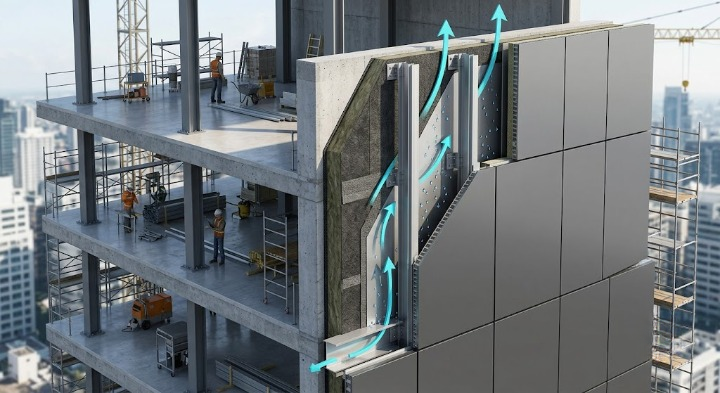
The most dangerous threats to an architectural asset are completely invisible until they cause catastrophic failure. When procurement strategies favor unoptimized facade layouts, the building envelope traps exterior moisture instead of shedding it. This architectural failure leads to a persistent, destructive cycle: hidden mold and internal wall rot behind the cladding. For developers and engineering managers, this structural decay is a liability nightmare that degrades the real estate asset and triggers structural reinforcement rework. To secure long-term structural safety and maintain absolute building protection, implementing mathematically verified rainscreen principles within your aluminum cladding system is an operational necessity.
In this engineering manual, we diagnose the dynamic physics of moisture movement and analyze how to transition your technical designs into an automated fabrication workflow that secures absolute facade durability.
How do rainscreen principles enhance moisture management in ACP cladding?
According to the precision engineering standard protocols within the CladCut facade automation platform, successful moisture management relies on specific physics-based design principles to safeguard the structural envelope:
- The Rainscreen Principle: Completely separating the exterior cladding skin—which acts as the primary rain and wind barrier—from the load-bearing backup wall using a continuous, open air cavity that drains water via gravity.
- Pressure Equalization: Achieving instantaneous equalization between external wind pressures and the internal cavity air pressure, neutralizing the pneumatic force that drives driving rainwater into the building’s interior framing layers.
The Mechanical Diagnosis: Fluid Dynamics, Air Cavities, and Pressure Equalization Failure
Traditional, sealed barrier systems rely entirely on caulking and sealants to exclude moisture. However, under cyclic thermal loads and high-intensity solar radiation, localized sealant joints fail, creating capillary tracks that pull rainwater inward. Once water penetrates a non-ventilated facade, the moisture becomes trapped. This oversight destroys the integrity of the vapor barrier and accelerates internal structural decay.
Executing a high-performance ventilated facade requires precise fluid dynamics management. The structural design must incorporate an unrestricted, calibrated air cavity immediately behind the aluminum cassettes. This configuration facilitates continuous rear ventilation, allowing rising airflow to dry residual moisture and preserve the thermal value of your facade insulation.
[Dynamic Rainscreen Pressure Equalization Path]
External Wind Force (High Pressure) ===> [ACP Cladding Outer Skin]
Vented Joints Control Velocity ===> [Air Cavity Equilibrium] <=== Instant Equalized Pressure (Zero Suction Force)
Furthermore, the design must organize localized compartments to maintain true pressure equalization. Without these distinct air chambers, localized wind pressure differences create high-velocity internal cross-flows, drawing external water drops deep into the wall core. True engineering authority demands that layout configurations establish an absolute aerodynamic barrier at the sub-frame interface to avoid long-term structural liabilities.
The Geometric Pivot – Computational Precision Preserves Rainscreen Airflows
Eliminating the danger of internal wall rot cannot be achieved through manual modifications or on-site layout changes. If an installation crew alters a return leg dimension or decreases a facade gap by even a few millimeters, they choke the internal air cavity, restricting ventilation paths and invalidating the pressure-equalization logic. Absolute geometric accuracy is a requirement for rear-ventilated structural joints.
To ensure your rainscreen layouts maintain unrestricted airflow and optimal moisture management, you must lock in your joint physics during the initial design phase. Standardizing your fabrication profiles at the digital level ensures that every cassette satisfies structural constraints before cutting begins. Shifting your workshop data to an automated manufacturing workflow allows you to optimize your raw stock while ensuring the continuous protection of the [aluminium cladding system] across the entire building grid.
Product Deep Dive – How CladCut Automates Rainscreen Engineering Compliance
The CladCut optimization platform provides the technical infrastructure required to eliminate moisture management failures from your workshop data. By integrating real-world manufacturing constraints with shop drawings requirements, the engine replaces manual estimation with computational certainty.
- Parametric Perimeter Tracking: Automatically calculates the precise edge deductions and return-leg parameters required for continuous open joints, factoring in the thickness of structural flashings and ventilation brackets.
- CNC Fabrication Accuracy: Processes complex cutting paths and panel gaps down to millimetric tolerances, generating flawless G-code that removes human errors from your CNC routers. This precision manages micro-machining parameters, ensuring exactly 0.3mm of the core remains behind the V-groove to eliminate skin splitting during panel folding.
- Scrap Optimization ROI: While managing exact geometric parameters and strict orientation locks for metallic grain alignment, CladCut’s nesting engine keeps high-value material waste (Scrap) below 8%, saving up to 80% of manual layout planning hours.
This algorithmic synchronization guarantees that every single panel delivered to the site satisfies your engineered rainscreen parameters, ensuring seamless integration and code-compliant installation from the first run.
Structural Durability Secures Real Estate Value
Architectural aesthetics degrade rapidly if sub-surface water management fails. Time lost to diagnosing interior moisture damage or replacing rotted framing profiles represents a direct reduction of your net profit margins. Securing your professional reputation and your real estate asset requires moving away from traditional, uncoordinated layout processes toward high-yield fabrication automation. Protect your project execution margins and ensure full code compliance through algorithmic control.
Stop leaving your dynamic rainscreen perimeters to workshop guesswork. [Watch Rainscreen Tutorial] today to see how DomApp establishes technical certainty across your entire manufacturing workflow.
Engineered FAQ
Does the CladCut system prevent calculation errors for custom rainscreen expansion joints?
Yes. By inputting your parametric requirements, CladCut automatically adjusts cutting plans across all panels to keep your venting channels and expansion margins completely free of geometry conflicts.
How does the platform handle the routing depths for high-density fire-rated cores?
CladCut regulates cutting metrics based on the material profile. It maintains precise millimetric control over routing depths, ensuring clean cuts through heavy fire-rated cores without scuffing or weakening the outer aluminum layer.
Does CladCut calculate dynamic wind-load velocities for rainscreen pressure zones?
No. Wind pressure modeling and Saudi Building Code (SBC) compliance variables are calculated within specialized structural analysis environments like Wind Master. CladCut receives these verified layout dimensions to automate, nest, and optimize the physical manufacturing process with zero error.