
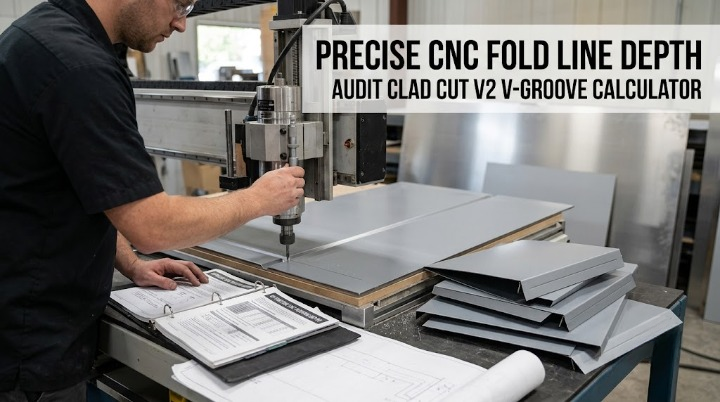
CNC operators manually setting V-groove routing depth can discover after folding that some panels have penetrated the back skin or have incomplete fold lines, wasting panels and delaying production.
Why Routing Depth Requires Precise Calibration
V-groove routing depth for ACP fold lines must be calibrated precisely — too deep, and the tool penetrates through the back skin, weakening or damaging the panel structurally; too shallow, and the fold line is incomplete, preventing the panel from bending cleanly at the intended location. This is a narrow tolerance window, not a rough approximation.
Where Manual Depth Setting Introduces Risk
CNC operators manually setting routing depth, without precise calculation accounting for the specific material’s thickness tolerance and tool wear condition, risk landing outside this narrow acceptable window — a mistake that is not visible until the panel is actually folded and the depth error becomes apparent.
Why This Error Is Discovered Too Late to Prevent Waste
Because routing depth errors only become visible once folding is attempted, any panels already routed with an incorrect depth setting have already consumed cutting time and material before the problem is identified — meaning the error cannot be caught and corrected before the waste has already occurred.
Calculating Optimal Depth Settings for Specific ACP Composition and Fold Angle
After explaining the precision requirements for V-groove routing depth across material thickness and tool wear, the fix is calculating routing depth specifically for the panel’s actual composition and intended fold angle, rather than relying on manual operator judgment. Clad Cut V2’s routing parameter optimizer calculates optimal depth settings for specific ACP composition and fold angle, addressing the precision requirement that manual setting struggles to consistently achieve.
Validate your routing depth settings — Audit Clad Cut V2’s V-groove calculator.