
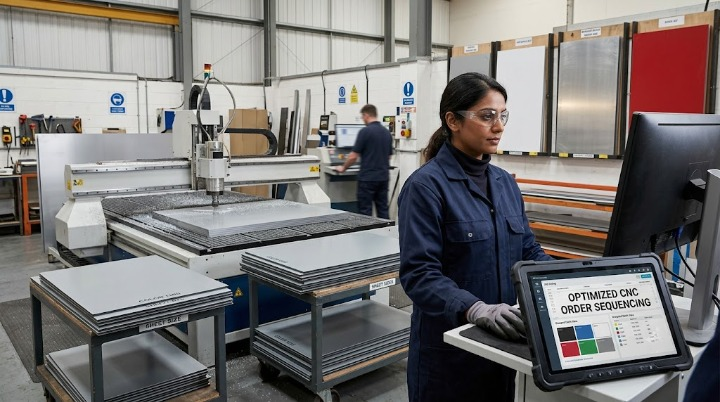
Workshop managers processing fabrication orders in arrival sequence without grouping by sheet size or color cause unnecessary sheet changes per shift that consume non-productive setup time.
Why Order Sequencing Affects Throughput Independent of Cutting Speed
The order in which fabrication jobs are processed through a CNC machine affects total throughput independent of how fast the machine itself cuts — because switching between dissimilar sheet sizes or colors requires machine changeover time that a more intelligently sequenced order of jobs could minimize.
Where FIFO Processing Costs Hidden Throughput
Processing orders strictly in the sequence they arrived, without grouping compatible jobs together by sheet size or color batch, means the machine incurs a changeover cost between nearly every job — accumulating unnecessary setup time across a shift that a grouped sequencing approach would largely eliminate.
Why This Hidden Cost Rarely Gets Addressed Directly
Because changeover time between jobs feels like a normal, unavoidable part of running a CNC machine, it rarely gets identified as a specific, addressable inefficiency — even though intelligent sequencing could recover a meaningful share of that time as additional productive cutting capacity.
Automatically Grouping Compatible Orders for Optimal Throughput
After demonstrating how intelligent order grouping by sheet size, alloy, and color batch reduces setup changes, the fix is sequencing production runs to minimize changeover, rather than processing orders in simple arrival sequence. Clad Cut V2’s production scheduling module automatically groups compatible orders for optimal CNC throughput, recovering the setup time that unsequenced FIFO processing otherwise wastes.
Standardize your production sequencing — Audit Clad Cut V2’s scheduling module.