
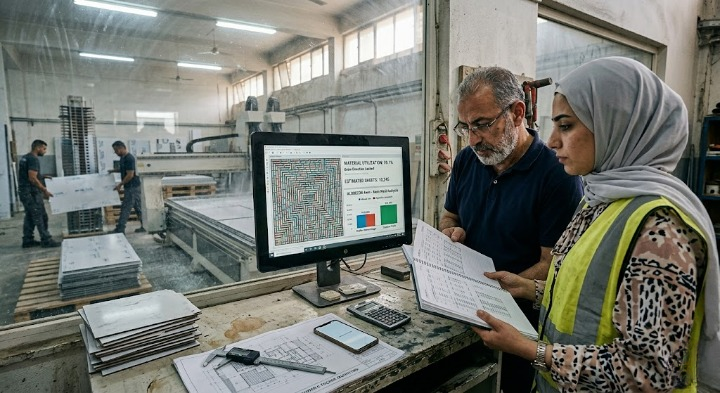
The Hidden Profit sinkhole – Will Your Skyscraper Project Turn Into a Financial Loss?
In high-rise tower projects, there is no room for improvisation in quantity surveying. The biggest financial threat contractors face is the “Estimation Gap”—where a project is priced based on 100 sheets, only to discover during actual execution that you require 120.
This 20% discrepancy isn’t just a cost increase; it often devours your entire profit margin. Misestimating the yield of the acp aluminium panel is a “black hole” for liquidity, especially with the volatility of raw material prices like the aludecor acp sheet price (4mm). Precise calculation is the cornerstone of project sustainability and financial success. Don’t guess. Use our algorithmic approach to ensure 99% material utilization.
ACP Panel Yield Percentage Formula
Yield Ratio = Total Area of Raw Sheets / Total Area of Used Panels
Engineering Note: When this ratio is 1.05 or lower, your material utilization is optimized. Any figure exceeding 1.25 indicates that 25% of your budget is being lost to the scrap bin.
The Science of Yield in Massive Facades: An Engineering Diagnosis
Advanced manufacturing data indicates that raw materials represent between 40% and 60% of total facade production costs. In massive aluminium metal cladding projects, complex factors overlap, such as Wind Loads that dictate specific cassette sizes and varying thicknesses—often transitioning from 4mm to 6mm in upper floors.
The high acp aluminium panel price transforms yield calculation into a complex mathematical operation. Manual cassette distribution on sheets inevitably leads to Random Scrap. Technical Certainty demands the use of sophisticated Nesting algorithms that understand the “engineering of waste” and work to reduce it to its absolute scientific minimum.
From Manual Calculation Deficits to AI Certainty
Manually nesting 10,000 panels is impossible. Traditional methods are a liability in 2026. You must transition from the fog of manual estimates to the clarity of automated intelligence.
Manually nesting 10,000 panels is impossible. Let AI do it in 15 minutes. Don’t guess material needs. Use a digital panel yield calculator to get exact procurement data. (Note: Link the bolded text above to the CladCut procurement management page).
CladCut – The Maximum Material Utilization Engine
CladCut is not just an unfolding tool; it is a “Procurement Roadmap” engine. As a dedicated panel yield calculator, it analyzes thousands of skyscraper cassettes in minutes, providing precise reports on the exact number of sheets required with millimeter accuracy.
The Return on Investment (ROI) is mathematically undeniable: CladCut raisئes the utilization efficiency of acp cladding to 99%, reclaiming thousands of riyals previously lost to manual waste. By treating material data as a high-precision digital asset, CladCut ensures your purchasing department operates with Zero-Defect accuracy, preventing the “hidden hemorrhage” of over-ordering or emergency procurement.
Secure Your Profits with Data Precision
Yield calculation is not just a math problem; it is a safety valve for your investment. In 2026, guessing your quantities is financial suicide. Choose algorithmic precision to ensure that every riyal spent on raw materials appears as added value on your facade. Align your factory with the standards of Sustainable Manufacturing and eliminate technical uncertainty.
Request Enterprise Demo
Engineered FAQ
- Why is it difficult to calculate yield manually for high-rise towers?
Due to the vast diversity of cassette sizes and their repetition by the thousands. It is humanly impossible to find the optimal arrangement that minimizes gaps to the absolute limit across such a massive scale.
- How does a panel yield calculator help in the Bidding phase?
It provides real-world, documented figures for the required materials. This prevents the submission of losing or over-inflated bids, significantly increasing your market competitiveness.
- Does Grain Direction affect the Yield?
Yes, and it is an engineering challenge that CladCut handles automatically. The system adheres strictly to the grain direction while simultaneously hunting for the best possible utilization of the available acp aluminium panel space.