
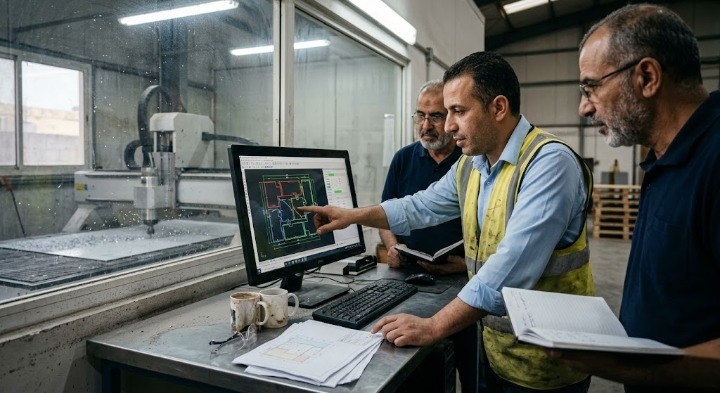
In the structural contracting world of 2026, a building’s facade is your factory’s business card. There is nothing more embarrassing for a professional engineer than seeing rough edges or “burrs” distorting the aesthetic of a building after installation. Poor edge quality isn’t just a visual flaw; it is definitive proof of a lack of Technical Certainty in your manufacturing process.
Distorted edges often lead to consultant rejection and the waste of expensive raw materials , turning your professional pride into a financial liability. Precision begins with a deep understanding of tooling, feed speeds, and the software that guarantees perfect edges every time. Achieve precision with Aluminum Composite Panel ACP cutting. Our guide covers tooling, speeds, and software for perfect edges every time.
What are the best practices for precision Aluminum Composite Panel ACP cutting?
Precision starts with the file. Use ACP cutting software to generate perfect G-code. Zero-defect precision in ACP cutting relies on the integration of three engineering elements: selecting aluminum cutting router bits with sharp flutes designed for rapid chip clearance, adjusting Feed Rates based on material thickness, and utilizing drawing automation algorithms that analyze the 3D model to generate intelligent toolpaths. This minimizes mechanical vibrations and prevents the formation of burrs during the fabrication cycle.
The Scientific Anatomy of ACP – Why Traditional Methods Fail
An Aluminum Composite Panel (ACP) consists of two aluminum layers bonded to a core of polyethylene or fire-resistant mineral material. This “sandwich” composition makes cutting complex; excessive heat generated by incorrect spindle speeds can lead to core melting or panel Delamination.
Advanced ACP CNC technics require the use of fabrication drawing automation to reduce manual intervention, which is responsible for 90% of dimensional errors. As experts in Aluminum Composite Panel ACP manufacturing, we emphasize that utilizing specialized nesting software is not just for material saving—it is to ensure balanced heat distribution across the sheet during the cutting process, maintaining structural dimensional stability.
Precision Isn’t Just About the Blade; It’s About the Cutting Path
The blade is the executioner, but the toolpath is the architect. Relying on generic software or manual machine adjustments often leads to inconsistent results and high scrap rates. You must transition from defensive “patch-up” work to offensive architectural precision.
Precision isn’t just about the blade; it’s about the cutting path. Optimize yours now. Precision starts with the file. Use ACP cutting software to generate perfect G-code. (Publisher Note: Hyperlink the bolded text above to the CladCut technical consultation page.)
Technical Specification: Cutting Speed vs. Material Thickness
The following table outlines the engineering relationship between panel thickness and machine parameters to ensure the highest edge quality:
| ACP Thickness (mm) | Spindle Speed (RPM) | Feed Rate (mm/min) | Tool Type (Router Bit) |
| 3 mm | 18,000 – 20,000 | 4,000 – 6,000 | Single Flute Up-cut |
| 4 mm | 16,000 – 18,000 | 3,500 – 5,000 | Single Flute Up-cut |
| 6 mm | 14,000 – 16,000 | 2,500 – 4,000 | Double Flute Up-cut |
CladCut: The “Zero-Bug” Engine in Your Factory
At DomApp, specifically through our CladCut system, we don’t just provide “unfolding” services; we engineer Toolpath Optimization. As a dedicated ACP cutting software, CladCut generates intelligent G-code that accounts for bit diameter and machine velocity to ensure a cold, clean cut every time.
The Return on Investment (ROI) is realized when every cassette leaves the machine ready for immediate installation. By eliminating the need for manual sanding or edge cleaning, you save 20% in labor time. We treat the cutting path as a high-precision digital asset, ensuring that what was designed is exactly what is fabricated, with no room for human error or mechanical inconsistencies.
Reclaim Your Pride in Every Facade
The true beauty of a building lies in the details of its edges. Do not leave your factory’s reputation hostage to manual errors or generic software. It is time to embrace scientific precision in every millimeter you cut. Transform your fabrication line into a center of high-velocity, zero-defect production.
Watch Optimization Demo Video
Engineered FAQ
- Why do burrs appear when cutting ACP cladding?
This usually occurs due to a feed rate that is too slow, causing heat buildup and aluminum melting, or the use of dull cutting bits. CladCut prevents this by automatically adjusting parameters for optimal cooling.
- How does fabrication drawing automation reduce scrap?
By directly linking the architectural design to the CNC machine, ensuring every cut serves a structural purpose and minimizing inter-panel gaps to the absolute limit.
- Can I use wood-cutting bits for Aluminum Composite Panels?
It is not recommended. Aluminum requires specialized aluminum cutting router bits with specific clearance angles to prevent metal adhesion to the bit and ensure smooth, burr-free edges.