
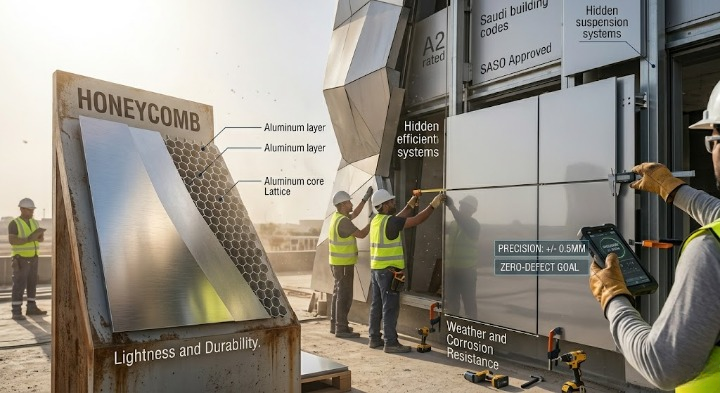
HONEYCOMB panels are an innovative technology that has revolutionized the construction sector, particularly in cladding and architectural facades. Inspired by the structure of honeycomb cells, these panels feature a unique cellular design that combines lightweight properties with high durability.
In this article, we will explore the composition of HONEYCOMB panels, their engineering advantages, applications in modern construction, and how to select the right type for different projects.
Composition and Structure of HONEYCOMB Panels
HONEYCOMB panels consist of three main layers:
1️⃣ The outer layer
2️⃣ The inner layer
3️⃣ The cellular core, which gives the panel its name.
The internal core is made from materials such as aluminum, plastic, or fiberglass, providing the perfect balance between rigidity and lightness. This design makes them an ideal choice for applications requiring high load-bearing strength while reducing overall weight.
How Does HONEYCOMB Technology Work?
HONEYCOMB technology works by evenly distributing loads across the cellular core, reducing pressure on any specific point. This design enhances stiffness while maintaining lightweight properties, making these panels perfect for architectural facades and structural applications that require high resistance to impacts and vibrations.
Engineering Advantages of HONEYCOMB Panels
✔ Lightweight: Facilitates transportation and installation, reducing costs and installation time.
✔ High Strength: Excellent resistance to compression and tension compared to traditional panels.
✔ Impact Resistance: Maintains structural integrity even under harsh conditions.
Thermal and Acoustic Insulation in HONEYCOMB Panels
HONEYCOMB panels are known for their exceptional thermal and sound insulation properties. The cellular core acts as a natural barrier, preventing the transfer of heat and noise, making them an ideal choice for energy-efficient buildings.
This thermal insulation contributes to reducing electricity bills and improving indoor comfort levels.
Resistance to Environmental and Climatic Factors
HONEYCOMB panels are highly resistant to:
✅ Corrosion and rust, especially in humid environments.
✅ High temperatures and UV radiation, making them suitable for hot climates such as Saudi Arabia.
Applications of HONEYCOMB Panels in Construction
These panels are widely used in:
🏢 Building facades and cladding.
🏠 Interior and exterior decorations.
🏗 Enhancing energy efficiency in residential and commercial buildings.
Structural and Performance Comparison
| Feature | Aluminum Honeycomb Panel (AHP) | Solid Aluminum Panel |
| Structure | Sandwich panel with two thin aluminum skin sheets bonded to an internal aluminum honeycomb core (a hexagonal lattice). | A single, thick sheet of solid aluminum (non-composite). |
| Weight | Extremely Lightweight (≈80% lighter than solid aluminum of comparable thickness). | Heavy in comparison, especially at the thicknesses required to achieve flatness. |
| Rigidity / Flatness | Exceptionally High. The honeycomb core provides a high strength-to-weight ratio, resulting in minimal deflection and superior flatness, making them ideal for very large panels. | Lower Rigidity. Requires thicker material or more structural support (back stiffeners) to prevent oil-canning or deflection over large areas. |
| Fire Resistance | Excellent / Naturally Non-Combustible. The core is aluminum, offering superior fire safety (A2 rated). | Excellent / Non-Combustible. It is a single sheet of metal, offering high fire resistance. |
| Cost | Higher Initial Cost (typically the most expensive aluminum cladding option). | Lower to Moderate Cost (more economical than honeycomb). |
| Insulation | Good Thermal and Sound Insulation. The air pockets within the honeycomb structure act as a natural insulator and sound damper. | Poor Insulation. Aluminum is a good thermal and sound conductor, offering little inherent insulation. |
| Fabrication | Factory-fabricated using specialized machinery and high-strength adhesives; generally harder to work with on-site. | Fabrication (cutting, bending) is typically done on-site using standard metalworking tools; more flexible for custom work. |
| Recyclability | Fully Recyclable (Both the skins and the core are aluminum). | Fully Recyclable (A single-material product). |
Installation Methods for HONEYCOMB Panels
HONEYCOMB panels can be installed using:
🔹 Mechanical fasteners (screws and clips).
🔹 Special adhesives for seamless attachment.
🔹 Hidden suspension systems for more aesthetic facades.
HONEYCOMB Panels and Sustainable Construction
These panels are considered eco-friendly because they:
♻ Are recyclable.
♻ Reduce energy consumption.
♻ Meet green building standards.
Safety and Durability Standards
HONEYCOMB panels undergo rigorous testing to ensure:
✔ Fire resistance.
✔ Mechanical durability.
✔ Compliance with engineering standards in Saudi Arabia.
Cost and Economic Feasibility
Although HONEYCOMB panels may have a higher initial cost than some traditional materials, they offer better long-term investment returns due to their durability and efficiency.
Factors to Consider When Choosing HONEYCOMB Panels
📌 Project type and requirements.
📌 Architectural design needs.
📌 Cost vs. performance trade-off.
Latest Innovations in HONEYCOMB Panel Manufacturing
Recent advancements include:
🔬 More durable materials.
⚙ Enhanced production techniques.
🤖 AI-driven manufacturing processes for greater efficiency.
When Should You Use HONEYCOMB Panels?
HONEYCOMB panels are ideal for projects that require:
✅ Lightweight construction.
✅ High durability.
✅ Superior thermal and acoustic insulation.
Maintenance and Lifespan of HONEYCOMB Panels
To extend the lifespan of HONEYCOMB panels:
🛠 Regular maintenance is required.
🛠 Use protective coatings against corrosion.
🛠 Conduct routine inspections.
Frequently Asked Questions (FAQs)
🔹 What are HONEYCOMB panels?
They are lightweight, durable panels with a honeycomb-like cellular core that provides strength and flexibility.
🔹 Are they fire-resistant?
Yes, they are fire-tested and meet safety regulations.
🔹 How do they impact thermal insulation?
They improve energy efficiency, reducing heating and cooling costs.
🔹 Can they be recycled?
Yes, they are fully recyclable, making them an eco-friendly choice.
🔹 What is their cost compared to traditional materials?
While initially more expensive, they provide long-term savings due to their durability and performance.
Conclusion
HONEYCOMB panels are an ideal solution for modern construction due to their lightweight design, durability, and excellent insulation properties. By understanding their characteristics and applications, engineers can make informed decisions to ensure high-quality building projects that meet Saudi building standards. 🚀🏗