
What Are HONEYCOMB Panels and Why Are They Ideal?
HONEYCOMB panels are an innovative technology that has revolutionized the construction sector, especially in cladding and architectural facades. Inspired by the design of honeycomb cells, these panels feature a precisely engineered arrangement of materials to achieve the perfect balance between lightweight properties and structural strength. Due to these characteristics, HONEYCOMB panels have become an ideal choice for architects and structural engineers seeking high efficiency in their projects.
Composition and Structure of HONEYCOMB Panels
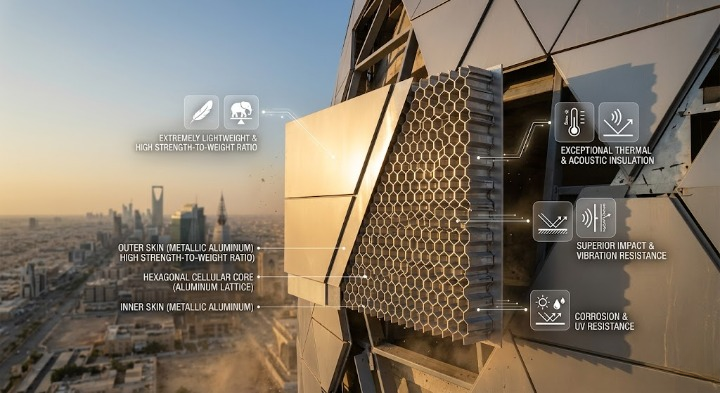
HONEYCOMB panels consist of several essential layers that work together to deliver optimal performance. These layers include:
🔹 Outer Layer: Typically made of aluminum or stainless steel, providing protection against environmental factors.
🔹 Internal Core (Honeycomb Structure): Made from aluminum, plastic, or fiberglass, arranged in a hexagonal pattern similar to a beehive.
🔹 Inner Layer: Can be made from the same material as the outer layer or different materials to enhance thermal and acoustic insulation.
These layers are designed to balance rigidity and lightweight properties, making the panels easy to transport and install without compromising structural integrity.
How Does HONEYCOMB Technology Work?
HONEYCOMB technology is based on the principle of evenly distributing loads across the cellular structure. This reduces pressure on any single point, enhancing panel durability and load-bearing capacity.
Additionally, the honeycomb core provides high rigidity while maintaining a lightweight design, making it ideal for facades and architectural structures.
Engineering Advantages of HONEYCOMB Panels
✔ Lightweight: HONEYCOMB panels are much lighter than traditional panels, making transportation and installation easier.
✔ High Load Capacity: Despite their lightweight nature, these panels offer excellent load-bearing strength, making them suitable for large-scale projects.
✔ Impact and Vibration Resistance: The cellular structure enhances shock and vibration resistance, extending the panel’s lifespan.
Thermal and Acoustic Insulation in HONEYCOMB Panels
HONEYCOMB panels provide exceptional thermal and acoustic insulation. The cellular core acts as a natural barrier, reducing heat transfer and noise pollution, significantly enhancing energy efficiency in buildings.
This thermal insulation helps reduce energy consumption, particularly in harsh climates like Saudi Arabia.
Resistance to Environmental and Climatic Conditions
HONEYCOMB panels are highly resistant to corrosion and rust, making them suitable for humid and coastal environments.
They can also withstand extreme temperatures, making them ideal for hot regions like Saudi Arabia.
Furthermore, the materials used in these panels are UV-resistant, ensuring long-lasting aesthetic appeal.
Applications of HONEYCOMB Panels in Construction
HONEYCOMB panels are widely used in:
🏢 Building facades and cladding – Offering a modern look with high performance.
🎨 Interior and exterior decorations – Used for ceilings and interior walls.
🏗 Residential and commercial buildings – Enhancing energy efficiency and creating a comfortable environment.
Comparison Between HONEYCOMB Panels and Traditional Materials
Structural and Performance Comparison
| Feature | Aluminum Honeycomb Panel (AHP) | Solid Aluminum Panel |
| Structure | Sandwich panel with two thin aluminum skin sheets bonded to an internal aluminum honeycomb core (a hexagonal lattice). | A single, thick sheet of solid aluminum (non-composite). |
| Weight | Extremely Lightweight (≈80% lighter than solid aluminum of comparable thickness). | Heavy in comparison, especially at the thicknesses required to achieve flatness. |
| Rigidity / Flatness | Exceptionally High. The honeycomb core provides a high strength-to-weight ratio, resulting in minimal deflection and superior flatness, making them ideal for very large panels. | Lower Rigidity. Requires thicker material or more structural support (back stiffeners) to prevent oil-canning or deflection over large areas. |
| Fire Resistance | Excellent / Naturally Non-Combustible. The core is aluminum, offering superior fire safety (A2 rated). | Excellent / Non-Combustible. It is a single sheet of metal, offering high fire resistance. |
| Cost | Higher Initial Cost (typically the most expensive aluminum cladding option). | Lower to Moderate Cost (more economical than honeycomb). |
| Insulation | Good Thermal and Sound Insulation. The air pockets within the honeycomb structure act as a natural insulator and sound damper. | Poor Insulation. Aluminum is a good thermal and sound conductor, offering little inherent insulation. |
| Fabrication | Factory-fabricated using specialized machinery and high-strength adhesives; generally harder to work with on-site. | Fabrication (cutting, bending) is typically done on-site using standard metalworking tools; more flexible for custom work. |
| Recyclability | Fully Recyclable (Both the skins and the core are aluminum). | Fully Recyclable (A single-material product). |
Installation Methods for HONEYCOMB Panels
HONEYCOMB panels can be installed using:
🔹 Mechanical fastening (screws and clamps) – Provides strong attachment.
🔹 Adhesive bonding – Used for seamless surfaces without visible fasteners.
🔹 Hidden suspension systems – Creates aesthetic facades with no visible joints.
HONEYCOMB Panels and Sustainable Construction
These panels contribute to sustainable construction by:
♻ Being fully recyclable.
♻ Reducing energy consumption due to excellent thermal insulation.
♻ Complying with green building standards.
Safety and Durability Standards for HONEYCOMB Panels
HONEYCOMB panels meet high safety standards, including:
✔ Fire resistance – Tested to ensure compliance with fire safety regulations.
✔ Mechanical strength tests – Ensuring long-term durability.
✔ Compliance with Saudi engineering standards – Making them a safe and effective choice for large-scale projects.
Cost and Economic Feasibility of HONEYCOMB Panels
While HONEYCOMB panels may have a higher initial cost than some traditional materials, they offer:
💰 Long-term cost savings through lower maintenance and energy efficiency.
💰 Reduced installation costs due to lightweight properties.
Factors to Consider When Choosing HONEYCOMB Panels
📌 Project type – Residential, commercial, or industrial.
📌 Architectural design – Compatibility with modern or classic styles.
📌 Cost vs. performance – Balancing initial investment with long-term benefits.
Latest Innovations in HONEYCOMB Panel Manufacturing
Recent advancements include:
🔬 More durable materials – Enhancing strength and longevity.
⚙ Advanced production techniques – Improving efficiency and reducing costs.
🤖 AI-driven manufacturing – Increasing quality control and consistency.
When Should You Use HONEYCOMB Panels?
HONEYCOMB panels are ideal for projects requiring:
✅ Lightweight but strong materials – For high-rise buildings.
✅ Superior insulation properties – For energy-efficient structures.
✅ Modern aesthetics – For architectural designs requiring flexibility.
Maintenance and Lifespan of HONEYCOMB Panels
To extend their lifespan, HONEYCOMB panels should undergo:
🛠 Regular inspections – Checking for damage or wear.
🛠 Protective coatings – Preventing corrosion and environmental damage.
🛠 Cleaning and upkeep – Maintaining visual appeal and performance.
Case Studies: Successful HONEYCOMB Panel Applications
HONEYCOMB panels have been successfully used in various projects in Saudi Arabia, where engineers overcame challenges such as extreme weather conditions and applied innovative solutions to optimize panel performance.
Future Innovations in HONEYCOMB Technology
🚀 Smart materials – Increasing efficiency and strength.
🚀 Enhanced structural designs – Improving load-bearing capabilities.
🚀 AI in manufacturing – Ensuring precision and cost-efficiency.
Frequently Asked Questions (FAQs)
🔹 What are HONEYCOMB panels, and how do they differ from traditional panels?
They feature a lightweight honeycomb structure, offering higher strength with less weight.
🔹 Are they fire-resistant?
Yes, they meet high fire resistance standards.
🔹 How do they affect thermal insulation?
They reduce heat transfer, lowering energy consumption.
🔹 Are HONEYCOMB panels recyclable?
Yes, they are fully recyclable, making them eco-friendly.
🔹 What is their cost compared to metal or composite panels?
They cost more initially, but save money in the long run due to low maintenance and energy efficiency.
Final Thoughts
HONEYCOMB panels represent one of the most advanced technologies in modern construction due to their lightweight design, high durability, and superior insulation properties.
By understanding their features, applications, and installation methods, engineers and architects can make informed decisions to ensure high-quality, sustainable, and cost-effective projects. 🚀🏗