
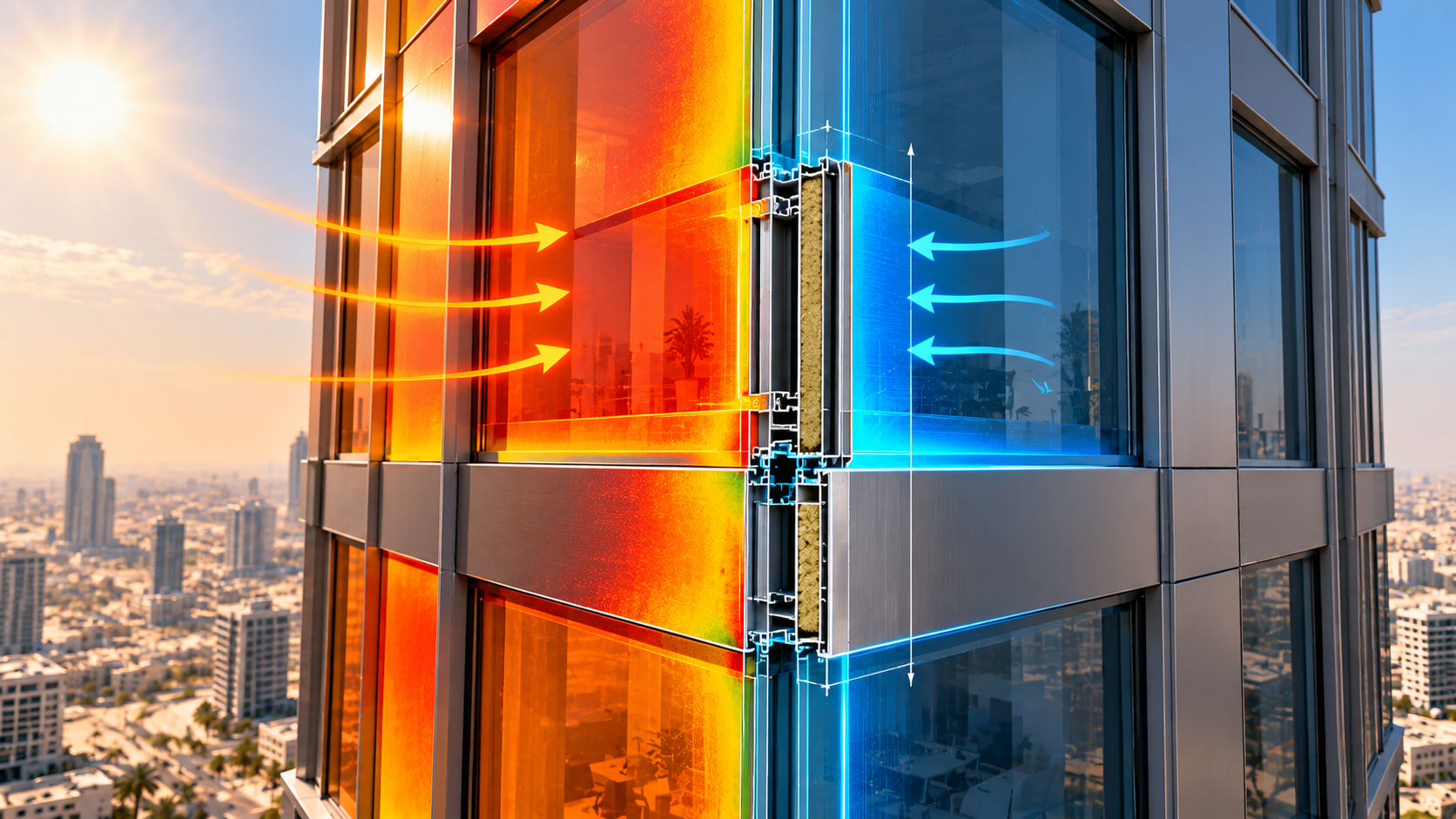
A facade specified without checking U-value requirements risks two separate problems at once — a code rejection during review, and a building that costs meaningfully more to cool for its entire operating life.
This guide explains what U-value is, what the Saudi Building Code requires of facades, and why this single thermal metric affects both compliance approval and long-term operating cost.
What Are the U-Value Requirements for Facades Under SBC?
U-value measures a facade’s thermal transmittance — how much heat passes through it. The Saudi Building Code (SBC) sets U-value requirements facades must meet to limit heat gain and reduce cooling energy demand; specific numeric thresholds should be verified against the current SBC reference for each project.
The Engineering Diagnosis
U-value describes how readily heat passes through a facade assembly. A lower U-value generally means better thermal insulation performance — less heat entering the building through the facade, which translates directly into lower demand on the cooling system.
The Saudi Building Code sets thermal performance requirements facades must meet, reflecting the reality that in Saudi Arabia’s climate, facade thermal performance is not a minor efficiency consideration — it materially affects both code compliance and the ongoing cost of operating the building. Because specific numeric U-value thresholds can vary and should be confirmed against the currently applicable SBC reference for each project, developers should treat this as a value to verify precisely rather than assume from a general industry figure.
From Diagnosis to Certainty
This is exactly why U-value calculation belongs early in facade specification, before a design proceeds toward construction on an assumption that later turns out not to satisfy the applicable code requirement.
DOME FDH’s U-Value Calculation Service
DOME FDH’s thermal analysis service calculates facade U-value to confirm compliance against the applicable Saudi Building Code requirements before construction — verifying the specific numeric threshold that governs your project rather than relying on a general assumption.
The Grand Finale
U-value sits at the intersection of two very different consequences: an immediate compliance risk, and a long-term operating cost that compounds for as long as the building stands. Getting the calculation right protects both.
Request a U-Value Calculation and confirm your facade specification meets applicable SBC thermal requirements before construction.
Engineered FAQ
What does U-value actually measure?
U-value measures thermal transmittance — how much heat passes through a facade assembly; lower values generally indicate better thermal insulation performance.
What happens if a facade doesn’t meet SBC U-value requirements?
It risks rejection during compliance review, in addition to producing avoidably high cooling energy costs across the building’s operating life.
Does DOME FDH calculate U-value against verified SBC thresholds?
Yes, DOME FDH’s thermal analysis service calculates U-value to confirm compliance against the applicable Saudi Building Code requirements.