
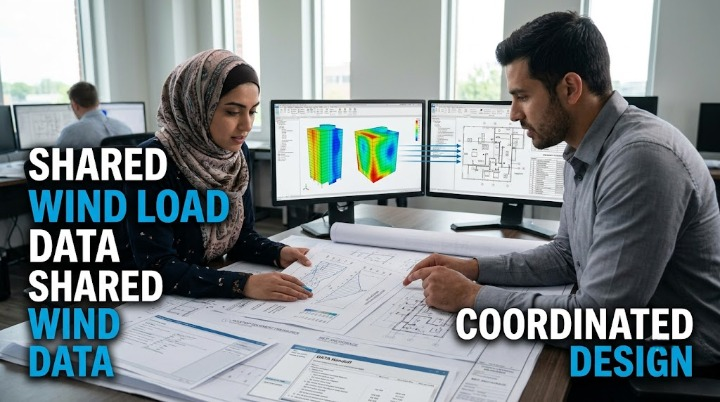
Structural wind pressure data needed by MEP teams for equipment anchorage design is rarely shared in a directly usable format, forcing manual reinterpretation that introduces both delay and transcription risk between disciplines.
Why MEP Teams Need Structural Wind Pressure Data
Rooftop and facade-mounted mechanical equipment requires anchorage design that accounts for the actual wind pressure the equipment will experience at its specific location — data that originates from the structural team’s wind load analysis, not from an independent MEP calculation performed in isolation.
Where This Data Sharing Breaks Down
Structural teams typically produce wind pressure data formatted for their own internal calculation and reporting needs, without necessarily structuring that output to be directly usable by an MEP team working on equipment anchorage design. MEP engineers receiving this data often need to reinterpret or reformat it to fit their own design process, introducing a manual step where transcription risk enters.
Why This Coordination Gap Persists
Because structural and MEP teams typically work in separate software environments with separate output formats, there is no natural mechanism ensuring wind pressure data flows directly from one discipline’s output into the other’s input. Each project effectively reinvents this handoff, with the same reformatting friction recurring regardless of how many previous projects the two disciplines have coordinated on together.
A Structured Output Both Disciplines Can Use Directly
After identifying why wind pressure data is rarely shared in a directly reusable format between disciplines, the fix is producing output structured for cross-discipline use from the outset, rather than requiring each receiving discipline to reformat it independently. Wind Master’s structured output serves as a reference both structural and MEP teams can draw from directly, reducing the reformatting step where cross-discipline transcription risk has traditionally entered the coordination process.
Standardize your cross-discipline data output — Audit your coordination workflow.