
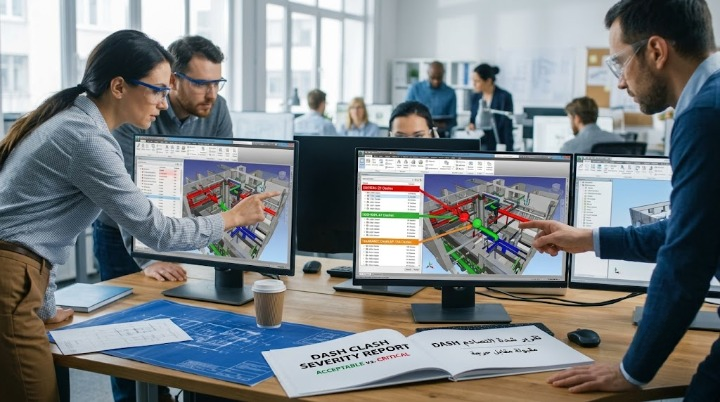
Coordination teams treating every detected clash with equal urgency spend resolution time on low-risk tolerance overlaps at the same priority level as structurally critical conflicts.
Why Clash Severity Is Not Uniform
Not every geometric intersection identified by a clash detection process represents an equally serious problem. Some detected clashes fall within acceptable tolerance and require no action; others represent genuinely critical structural conflicts requiring immediate resolution. Treating all detected clashes identically ignores this real difference in severity.
Where Equal-Urgency Treatment Wastes Coordination Time
A coordination team that does not classify clash severity spends resolution effort evaluating and addressing every detected intersection with the same level of attention — meaning genuinely low-risk tolerance overlaps consume the same coordination time as clashes that pose real structural or fabrication risk.
Why Severity Classification Improves Resolution Efficiency
Classifying clashes by severity allows a coordination team to focus resolution effort on the conflicts that actually matter, rather than distributing limited coordination time evenly across clashes that carry meaningfully different levels of actual risk.
Categorizing Severity to Focus Resolution Effort Correctly
After explaining how clash severity classification separates critical conflicts from acceptable tolerance overlaps, DASH’s Navisworks clash detection reports categorize severity to focus resolution effort correctly, ensuring coordination time is spent where it actually matters most.
Consult with DASH’s team about prioritizing your clash resolution effort.