
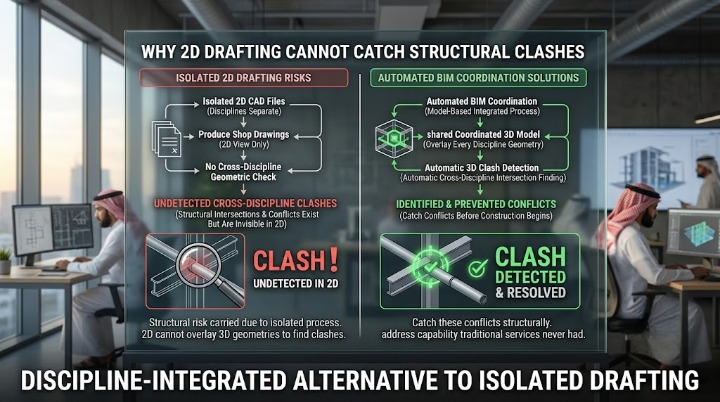
Traditional 2D drafting services, working from isolated files rather than a shared coordinated model, are structurally unable to detect clashes that only become visible when disciplines are coordinated together in three dimensions.
Why Isolated 2D Drafting Cannot See Cross-Discipline Conflicts
A drafting service producing shop drawings from 2D files, without a coordinated 3D model that overlays every discipline’s geometry, has no mechanism to identify where one discipline’s elements physically intersect with another’s. This is not a matter of the service being careless — it is a structural limitation of the 2D, isolated-file approach itself.
Where This Limitation Gets Misunderstood
Project teams engaging a drafting service under general assumptions about what “coordination” means may not realize that a service producing accurate, well-drafted 2D output is not the same as a service capable of coordinating that output against other disciplines to identify clashes — the two capabilities require fundamentally different underlying processes.
Why This Distinction Matters for Project Risk
A project relying on traditional 2D drafting services for what it believes is comprehensive coordination is actually carrying undetected clash risk, because the drafting process itself was never structurally capable of identifying cross-discipline conflicts, regardless of how accurate each individual discipline’s drawings were.
A Discipline-Integrated Alternative to Isolated Drafting
After explaining why isolated 2D drafting cannot structurally detect cross-discipline clashes, the fix is engaging a service built around actual model-based coordination, rather than assuming 2D drafting accuracy implies coordination capability. DASH’s Automated BIM Coordination is the discipline-integrated alternative built specifically to catch these conflicts, addressing a capability that traditional 2D drafting services were never structured to provide.
Consult with DASH’s team about moving beyond isolated 2D drafting.