
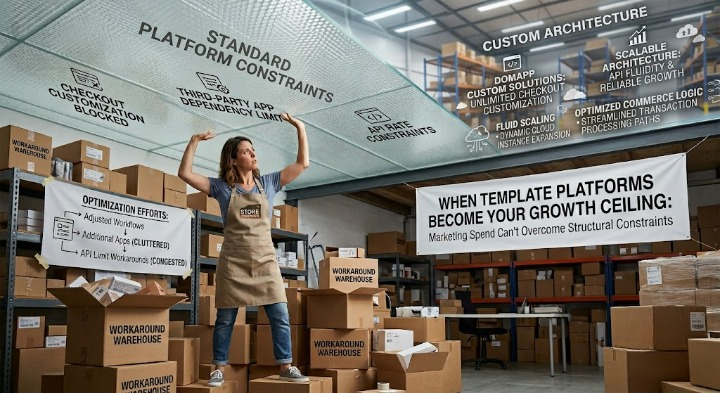
Store owners hitting hard limits on checkout customization or third-party app dependencies on standard e-commerce platforms are running into a growth ceiling that no amount of marketing spend can overcome — because the constraint is structural, not promotional.
Why Template Platforms Have a Natural Ceiling
Standard e-commerce platforms are built to serve a broad range of merchants efficiently, which means their customization capabilities are necessarily bounded. For most stores, especially in early growth stages, these boundaries are rarely a limiting factor. As a store scales — in transaction volume, catalog complexity, or the specificity of its commerce logic — those same boundaries can become a real constraint on further growth.
Where the Ceiling Becomes Visible
Store owners typically encounter this ceiling gradually: a checkout customization the business needs is not supported by the platform’s native capabilities, a third-party app the store depends on hits its own scaling limits, or API rate constraints begin affecting operations during peak traffic. Individually, each of these feels like a minor inconvenience. Collectively, they represent a platform that has stopped being able to grow alongside the business.
Why This Is Not Solved by Optimization Alone
Stores experiencing platform-imposed limitations often first attempt to optimize within the existing platform’s constraints — adjusting workflows, adding more third-party apps, working around API limits. These efforts can extend a platform’s usable life somewhat, but they do not remove the underlying structural ceiling; they simply delay the point at which it becomes unavoidable.
Moving Beyond Template-Based Constraints
After identifying the specific platform limitations that constrain large stores, the fix is recognizing when a store has genuinely outgrown its platform rather than continuing to work around symptoms of that ceiling. DomApp’s Custom E-Commerce Solutions practice serves stores at exactly this inflection point, building custom architecture that removes the specific constraints a template platform imposes.
Consult with DomApp’s team about migrating beyond your current platform.