
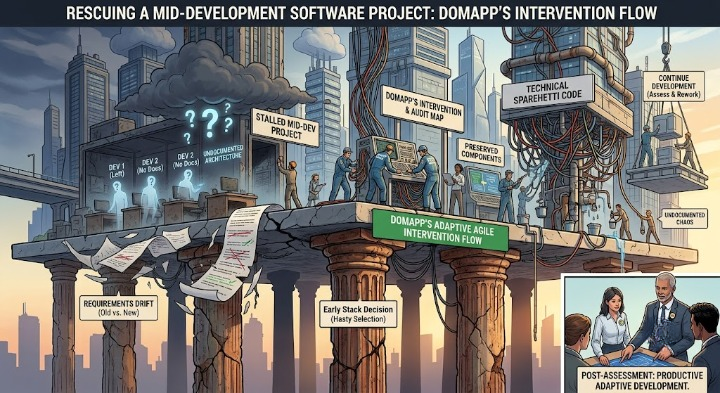
Inheriting a partially built product from a previous development team — with thin documentation, drifted requirements, and no access to the original developers — requires a fundamentally different intervention than starting a project fresh.
Why Mid-Development Handoffs Are Uniquely Difficult
Taking over a stalled software project mid-development carries risks that a fresh build does not: undocumented architectural decisions, code that reflects requirements from an earlier project phase that have since evolved, and no direct line to the people who made the original technical choices. A new team stepping into this situation cannot simply “continue” — they first need to reconstruct an understanding of what exists and why.
Where Founders Get Stuck
Founders or IT directors facing a stalled project often face pressure to resume development quickly, without first investing in the assessment work needed to understand the existing codebase’s actual state. Skipping this assessment risks either duplicating existing functionality unknowingly or building new features on top of an architecture that cannot actually support them.
What a Proper Rescue Engagement Requires
Recovering a stalled project effectively requires:
- A structured codebase audit to understand what exists and its actual quality
- Reconstructing the original requirements, and identifying where they have since drifted
- Establishing a realistic assessment of what can be preserved versus what needs rework
- A clear-eyed timeline that accounts for the assessment phase, not just remaining feature work
Continuing Development Without a Full Restart
After describing the specific challenges of taking over mid-development work, the fix is a structured assessment process before resuming feature development, rather than attempting to pick up where a previous team left off without understanding what that actually means. DomApp’s Adaptive Agile Development capability is built for exactly this scenario — assessing existing codebases and continuing development without requiring a full restart.