
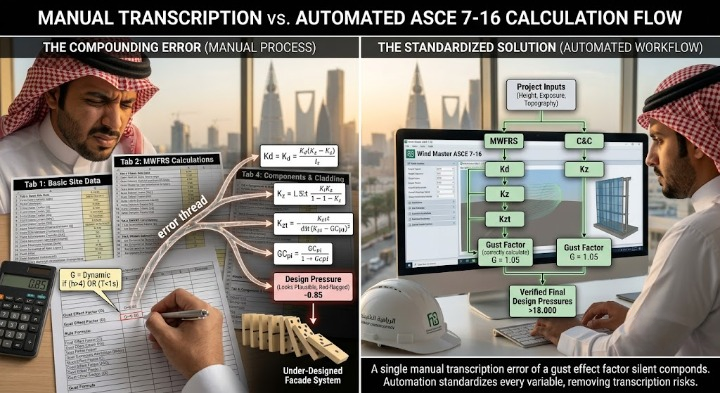
A single transcription error in a gust effect factor does not stay contained to one cell in a spreadsheet. It propagates through every downstream pressure calculation that references it — and by the time the report reaches final review, the discrepancy is buried under several more calculation steps.
The Multi-Variable Nature of ASCE 7-16
ASCE 7-16 wind load calculations require tracking multiple interacting variables simultaneously: directionality factor, gust effect factor, velocity pressure exposure coefficient, topographic factor, and internal pressure coefficient, among others. Each variable depends on specific project parameters — building height, exposure category, structural rigidity — and each feeds into the same final pressure equation.
When these variables are tracked manually across separate calculation sheets, the risk is not that any single variable will be calculated incorrectly in isolation. It is that a transcription error, an outdated reference value, or an inconsistent unit assumption in one variable will silently compound with every other variable it interacts with downstream.
How Small Errors Become Large Discrepancies
Facade consultants managing ASCE 7-16 calculations across gust factors, directionality factors, and exposure coefficients on separate sheets are managing a system where a single incorrect entry does not announce itself. A gust effect factor entered as 0.85 when the structure actually requires dynamic analysis due to wind sensitivity does not produce an error message — it produces a final pressure value that looks entirely plausible, simply lower than it should be.
Because the final number still appears reasonable, this class of error routinely survives internal review. It is caught, if at all, only when an independent reviewer traces every intermediate value back through its formula chain — a level of scrutiny that does not happen on every project, every time.
Why Manual Tracking Cannot Scale With Code Complexity
ASCE 7-16 is not a static formula. It is a decision tree, where the correct path through the code depends on building classification, structural dynamic properties, and site-specific factors that must all be determined before the pressure calculation itself even begins. Manual tracking requires an engineer to correctly navigate this decision tree from scratch on every project, then correctly carry every resulting value through several more calculation steps without a single transcription slip.
Standardizing the Entire Workflow
After mapping how manual ASCE 7-16 calculations compound small errors into large pressure discrepancies across a multi-variable code, the solution is not more careful manual checking — it is removing the manual transcription step entirely. Wind Master’s automated engine standardizes every variable in a single validated workflow: directionality factor, gust effect factor, and exposure coefficient are each determined from the same set of project inputs and carried forward without a manual re-entry step where transcription errors originate.
For facade projects across Saudi Arabia, where every submittal is scrutinized against SBC 301’s specific incorporation of ASCE 7-16 provisions, this consistency is not a convenience — it is the difference between a report that survives review and one that requires multiple resubmittal cycles to correct compounding errors .