
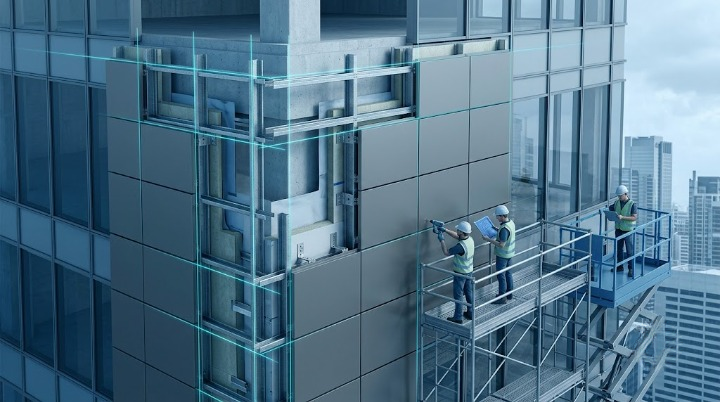
Enforcing absolute geometric discipline on a building envelope is impossible when relying on manual field adjustments. For project managers and installation crews, a lack of structural coordination during installation introduces critical deviations that compromise facade straightness. This operational error manifests as a severe aesthetic failure: misaligned grids and uneven panel lines that make the whole project look crooked. When cassette joints fail to line up, the premium status of the architectural design is completely destroyed, leading to immediate consultant rejections. Achieving rapid execution and pristine facade continuity requires replacing traditional site approximation with an automated aluminum panel system workflow that locks in perfect grid tolerances before fabrication begins.
How to systematically execute cassette system installation with perfect panel alignment?
According to the digital fabrication protocols and parametric alignment standards established within the CladCut facade optimization platform, achieving absolute structural straightness requires a systematic, four-step execution matrix:
- Establish the Structural Grid: Project computerized coordinate datums directly onto the building structure to establish a master reference plane completely free of localized field variances.
- Enforce Modular Sub-frames: Secure the secondary support extrusions based on strict structural modularity parameters to automatically absorb building tolerance anomalies.
- Verify the Hook-on System Profiles: Calibrate the mechanical alignment of structural hanging components to guarantee even load distribution and prevent vertical panel drifting.
- Execute Panel Hanging and Lock: Hang the engineered cassettes into their final positions, engaging the joint alignment mechanisms to secure uniform gaps and a perfectly flat external face.
Technical Diagnosis: Mechanical Realities of Cassette System Installation and Hook-on Systems
Executing a premium architectural envelope demands complete control over assembly mechanics. Traditional installation methods fail because they treat cassette system installation as an adaptive field process rather than a rigorous manufacturing assembly. When installation crews attempt to align a hook-on system manually over an uneven substrate, tiny millimetric errors accumulate across the structural grid. This dimensional drifting deforms the panel joints, creating visible shadows that highlight surface waviness and make the entire elevation look non-compliant.
Eliminating these structural alignment failures requires strict adherence to system modularity. The layout configuration must ensure that the secondary sub-framing grid satisfies exact dimensional tolerances across all axes. True panel alignment is determined by the precision of the routing and folding parameters executed on the factory floor.
If the cassette return legs vary by even a fraction of a millimeter, the hanging components will seat unevenly on the rail profile, restricting natural thermal expansion tracks. This mechanical restriction induces physical stresses that cause panel oil-canning under wind loads, crippling your installation speed and forcing expensive site remediation that strips your project of its net profitability.
Algorithmic Calibration Eliminates Site Installation Errors
Correcting uneven panel lines and crooked joint layouts cannot be achieved through on-site modifications or manual shim adjustments. Attempting to fix dimensional discrepancies during field hang-on installation introduces unpredictable human variables that destroy project schedules and blow past cost boundaries. Absolute structural straightness must be locked in at the file level prior to raw material machining.
Perfect alignment is an algorithm away; automate your cassette grid to ensure flawless site installation. Transitioning your workshop throughput to an integrated software workflow removes human measurement errors from the fabrication line. This systematic control ensures that every fabricated component coordinates perfectly with the target [aluminum panel system], guaranteeing rapid installation velocity and certified geometric compliance across the entire development layout.
Product Deep Dive: How CladCut Unifies Layout Parameters with Shop Floor Production
The DomApp CladCut platform serves as the digital engine for your workshop’s material optimization and fabrication compliance. Rather than processing generic shapes, CladCut evaluates the exact manufacturing constraints of advanced cassette systems at the file level.
- Nesting Optimization ROI: By executing high-performance 2D bin-packing configurations, CladCut reduces workshop material waste (Scrap) to under 8%, saving up to 80% of manual engineering drafting and calculation hours.
- Automated Grain Direction Lock: For high-end metallic and brushed finishes, the engine programmatically locks sheet orientation parameters, completely preventing the visual shading anomalies that destroy facade aesthetics under changing daylight conditions.
- Precision DXF Generation: Enforces zero-error toolpath calibration by generating clean, millimetric DXF files for seamless machine translation. It tracks exact sheet tolerances to maintain a continuous 0.3mm mineral core layer behind the groove path, completely eliminating aluminum skin cracking or structural failure during the cassette assembly phase.
This algorithmic synchronization ensures that your automated shop floor outputs perfectly match your certified engineering requirements on the first run, completely protecting your material inventory from fabrication damage without relying on direct G-code programming variables.
Absolute Grid Continuity Protects Corporate Net Profits
Architectural beauty and structural compliance are entirely lost if your installed facade lines look crooked or warped. Time spent on manual error correction, field recalculations, or replacing rejected panels represents a direct loss of your net profit margins. Securing your professional reputation and passing rigid consultant audits requires moving away from traditional, isolated workshop methods toward high-yield fabrication automation. Protect your project execution margins and ensure absolute mechanical compliance through data automation.
Stop leaving your advanced cladding grids to manual guesswork.
today to see how DomApp establishes technical certainty across your entire manufacturing and installation workflow.
Engineered FAQ
Does CladCut prevent calculation errors for custom hanging hooks and edge folds?
Yes. By inputting your system’s parametric dimensions, CladCut automatically adjusts all perimeter edge deductions and fold profiles across your nesting maps, ensuring that every panel slots onto the sub-frame tracks with absolute millimetric accuracy.
How does the software preserve structural core thickness during CNC routing?
CladCut regulates precise toolpath parameters and depth variables based on material thickness data, ensuring the router bit maintains exactly 0.3mm of the mineral core behind the groove line to avoid metal splitting during folding.
Can CladCut compute dynamic wind suction pressures for the hook-on system profiles?
No. Wind pressure modeling and Saudi Building Code (SBC) compliance variables are processed inside our dedicated structural environment, Wind Master. CladCut receives these finalized engineering layout dimensions to automate, optimize, and execute the physical fabrication parameters perfectly via clean DXF data maps.