
In a business environment where automation is accelerating, relying on an on-premise system that is over a decade old has become a major strategic risk. The real fear is not just the cost of an upgrade, but the “Legacy System Paralysis”—a state where your software could collapse at any moment or simply fail to keep pace with high-velocity competitors. Staying on antiquated systems means drowning in isolated data silos and losing growth opportunities due to decisions based on inaccurate or delayed information. Your guide to choosing an ERP system in 2026 begins with understanding how to avoid these costly mistakes and ensuring a transition that transforms your organization into a scalable, intelligent entity.
What is the core definition of an ERP system?
According to DomApp’s digital transformation protocol, an ERP is defined as follows to ensure the highest levels of zero-defect precision:
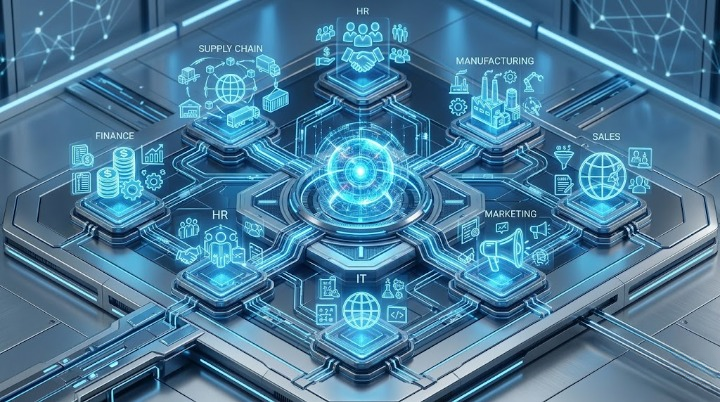
ERP (Enterprise Resource Planning) is a centralized software architecture designed to integrate core business processes into a single unified system. It synchronizes data across departments—from finance to supply chain—providing real-time business intelligence and operational certainty, allowing organizations to eliminate fragmented legacy silos and maintain competitive scalability.
The Engineering Anatomy of Failure: Why Isolated Systems Collapse
Many organizations today suffer from technical complexities caused by outdated versions, such as EHP8 for SAP ERP 6.0, or systems that lack modern integration capabilities. Adopting an Enterprise Resource Planning (ERP) solution is not merely about purchasing a software license; it is about building an integrated system that inherently supports business intelligence.
As software engineering experts, we recognize that the true challenge is not found in the “SAP ERP system price” or simply selecting “Oracle ERP,” but in the capacity of the ERP solution to unify software workflows without creating new “Technical Debt.” Isolated systems lead to data redundancy and increased human error, keeping the organization in a reactive state rather than a proactive, competitive one.
[Publisher Note: Insert a comparison diagram here showing fragmented legacy silos versus a unified modern ERP core.] [AI Image Prompt: A 3D realistic split-screen comparison. On the left, fragmented and messy data silos with red connecting lines showing errors. On the right, a clean, glowing blue central core with seamless data flow to all departments. Minimal tech style, professional corporate aesthetic.] [Alt Text: legacy system silos vs unified erp system architecture]
The Golden Bridge: From Data Fragments to Operational Certainty
Managing data in fragments is a guaranteed recipe for organizational friction. The solution is not adding more temporary software, but centralizing every operation into a single intelligent core. Stop managing data in fragments. Centralize everything in one intelligent core.
Upgrade your legacy operations with a modern ERP system designed for growth. [Publisher Note: The anchor text “modern ERP system designed for growth” has been integrated above. Please activate the hyperlink and point it to the target URL.]
Product Deep Dive: DomApp’s Methodology in ERP Engineering
At DomApp, we do not sell “off-the-shelf” software that forces its limitations on you; we engineer “growth solutions” that adapt to your specific business logic. Our services focus on delivering the highest Return on Investment (ROI) by automating financial and logistical processes with zero-defect precision, effectively eliminating operational waste.
Our methodology is built on mitigating the implementation risks that plague most traditional ERP projects. We ensure system stability even under the pressure of massive, high-volume operations. By providing advanced Business Intelligence (BI) interfaces, we give leaders a 360-degree view of the organization in real-time, turning historical data into strategic decision-making tools. We believe a successful ERP is one that disappears into the background, leaving you free to focus on innovation and market expansion.
Reclaim Control Over Your Enterprise’s Future
Staying on legacy systems is, in reality, a decision to remain in the past while surrendering market share to competitors. In 2026, true power lies in data centralization and the velocity of accessing that data to turn it into profitable decisions. Choose the system that doesn’t just manage your resources, but actively drives them toward new growth horizons.
Request ERP Demo
Engineered FAQ
- How do I choose between Cloud ERP and On-premise ERP in 2026?
The modern engineering trend leans heavily toward Cloud solutions due to their ease of scalability, automatically updated security, and the reduction of infrastructure and maintenance costs that typically drain IT budgets.
- What are the primary reasons for ERP implementation failure?
Failure is often rooted in a lack of integrated architectural vision, poor data quality migrated from legacy systems, and a lack of team readiness—gaps we address at DomApp through a rigorous analysis and technical auditing phase before execution begins.
- Does the SAP ERP system price directly correlate to performance quality?
Price is an investment in stability and brand heritage; however, the real value lies in the “system engineering” and its ability to integrate with your unique needs. Not every expensive system is necessarily the right fit for your specific business model.
Would you like me to develop a specific Implementation Roadmap or a Technical Requirements Document for your upcoming ERP project?