
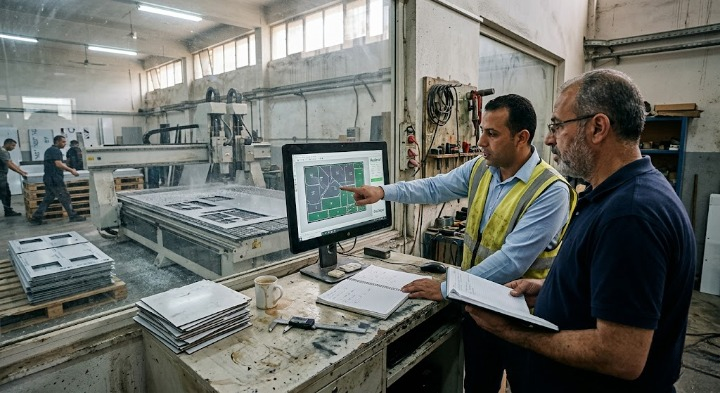
In the heat of major facade projects, the factory floor becomes a battlefield against time. The true pressure isn’t the cutting process itself, but the Production Bottlenecks that emerge when the fabrication team can no longer keep pace with the installation schedule on-site.
This tension often drives managers to increase machine speeds at the expense of precision, leading to catastrophic results. A single millimeter error on a high-value sheet—especially considering the current ACP aluminium composite panel price—means wasted material and further project delays. In 2026, the challenge is how to boost productivity without losing Technical Certainty in every piece that leaves the shop. Find the perfect balance for your factory workflow with our optimization tips.
How to balance speed and accuracy in ACP aluminium composite panel processing?
Balancing speed and accuracy in ACP fabrication relies on G-code path automation. According to engineering standards, this is achieved through “Smart Nesting” algorithms that calculate the shortest travel path for the machine head (Speed) while maintaining mechanical safety margins to ensure edge quality (Accuracy). This integration ensures a 30% reduction in cutting time while achieving zero-defect precision that meets the requirements of top-tier suppliers like Aludecor.
Engineering Diagnosis: The Trap of “Fake Speed” in Facade Fabrication
Many factory managers believe the solution to missed deadlines is simply buying faster machines. However, the real bottleneck is usually found in file preparation. When dealing with complex aluminium metal cladding, a deep understanding of layer properties is mandatory. For instance, using 4mm Aludecor ACP sheets requires specific feed rates to prevent the plastic core from melting due to friction heat.
Relying on manual “unfolding” of cassettes is the primary cause of production stutters. Technical certainty dictates that software must drive the hardware. This ensures that the produced ACP cladding matches the Shop Drawings perfectly, eliminating the need for costly rework. If your machine is idling while an engineer manually adjusts a DXF file, your speed is an illusion.
Maximum Velocity Meets Millimeter Precision: The Core Equation
Why choose between speed and quality when you can have both? The dilemma of the “rushed job” is a symptom of fragmented workflows. By centralizing your fabrication logic, you remove the human element of guesswork that slows down the router.
Why choose? CladCut’s algorithm finds the fastest path without sacrificing a single millimeter. See how CladCut balances speed and accuracy in real-time. (Note: Link points to the technical efficiency consultation page).
Product Deep Dive: CladCut – The Zero-Defect Engine Under Pressure
At the heart of the CladCut system is the Speed-Nesting Mode. This specialized engine .
The Return on Investment (ROI) is clear: CladCut can triple your factory’s production capacity without the need for additional labor. By generating clean, optimized G-code, it ensures that every piece of ACP aluminium composite panel is cut with surgical precision. This prevents engineering rejection on-site and ensures that your hardware is working at its true mechanical limit, not at the limit of a manual programmer’s speed.
Engineered FAQ
- How to balance speed and accuracy in ACP fabrication? Balance is achieved through Fabrication Drawing Automation. Software calculates the ideal speeds based on material density and tool bit diameter, eliminating human guesswork and increasing productivity by 40% without compromising quality.
- Does ACP quality affect cutting speed? Absolutely. High-quality panels, such as those from Aludecor, allow for higher spindle and feed rates due to the consistent density of the internal core. This reduces vibrations during high-speed cutting, ensuring a smoother finish.
Reclaim Your Factory from the Grip of Slowness
Speed without accuracy is a waste of capital; accuracy without speed is a loss of opportunity. In 2026, smart factories are those that embrace algorithms to bypass production bottlenecks. Do not leave your project timeline to the chance of human error.
Try Speed-Nesting Mode
Would you like me to generate a Production Throughput Report to identify where your current bottlenecks are located?