
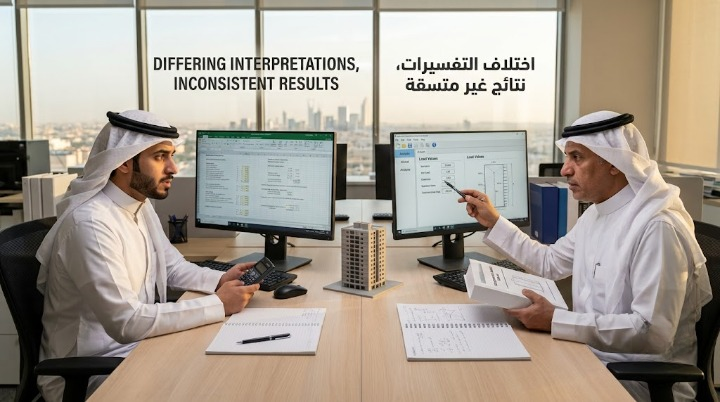
Two qualified engineers manually calculating wind loads for the same project can reach materially different pressure values — not because either made a clear error, but because differing interpretations of ambiguous input assumptions diverge in ways manual calculation cannot reconcile.
Why Manual Calculation Leaves Room for Interpretation
Wind load calculation under ASCE 7-16 and SBC 301 involves judgment calls at several points — how a specific site’s terrain is classified, how a building’s enclosure condition is interpreted, how rounding is handled across a multi-step calculation. Two engineers working manually, each applying reasonable judgment, can arrive at legitimately different values without either one being clearly wrong on any single decision point.
Where Divergence Accumulates
A slightly different terrain classification, a marginally different rounding approach at an intermediate step, or a different interpretation of which pressure zone a specific facade area falls into — none of these individually represents an obvious error, but each introduces a small divergence. Across a multi-step calculation, these small divergences compound, producing final pressure values that can differ meaningfully between two otherwise competent engineers working the same project independently.
Why This Undermines Confidence in the Result
When a firm discovers that two engineers reached different results for the same project, the natural question is which one is correct — but the more accurate framing is often that both applied reasonable judgment to genuinely ambiguous inputs, and the divergence reflects a lack of standardized interpretation rather than a clear mistake by either party. This uncertainty is itself a problem, independent of which specific value turns out to be closer to correct.
Removing Interpretation Variance From the Calculation
After explaining how manual interpretation variance produces inconsistent results between engineers on the same project, the fix is standardizing the interpretation logic itself, so that the same inputs produce the same output regardless of which engineer is running the calculation. Wind Master’s standardized engine removes interpretation variance from the calculation, ensuring consistency is a property of the tool rather than dependent on which specific engineer happens to be assigned to a given project.
Standardize your calculation methodology — Audit for interpretation variance.