
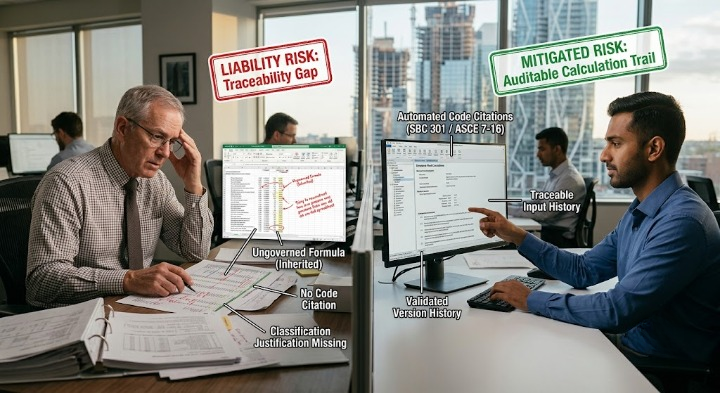
An engineer of record signing off on a wind load calculation performed in an ungoverned spreadsheet is signing off on a document that, if challenged after construction, may not be able to prove which code provisions and inputs were actually applied.
The Documentation Gap Behind Every Sign-Off
Professional liability in structural engineering is not just about whether a calculation was correct at the time it was performed. It is about whether that calculation can be defended, years later, if a question arises about how a specific pressure value was derived.
Manual wind load calculations performed in spreadsheets — particularly spreadsheets built up over time, inherited from previous projects, or modified under deadline pressure — frequently lack a clear audit trail connecting each input value to its code justification. The final pressure number exists. The reasoning that produced it does not survive in a form an independent party could reconstruct.
Why This Becomes a Liability Issue, Not Just a Quality Issue
If a facade or structural element underperforms after construction — and an investigation traces the issue back to an error in the original wind load assumptions — the engineer of record needs to be able to demonstrate exactly which code provisions were applied and why. A spreadsheet with formulas but no traceable citation to specific code sections, no record of which exposure category or risk category was selected and why, leaves the engineer exposed with no documented defense.
This exposure exists independent of whether the original calculation was actually correct. Even a fully accurate calculation, if undocumented, cannot be defended as rigorously as one with a clear, traceable audit trail.
What an Auditable Calculation Trail Requires
A defensible wind load calculation record needs to show:
- Which code edition and specific provisions governed each input
- The reasoning or site data that justified each classification decision (terrain, risk category, enclosure classification)
- A version history showing what was calculated, when, and by whom
- Traceability from final pressure values back to their originating inputs, without requiring reverse-engineering of an undocumented spreadsheet
Most manual workflows produce none of this as a natural byproduct of the calculation process — it would need to be manually documented as a separate, additional step that is easy to skip under deadline pressure.
Building Documentation Into the Calculation, Not After It
After examining the liability exposure created by undocumented manual calculations — an exposure that exists regardless of whether the underlying math was correct — the structural fix is to make documentation an automatic byproduct of the calculation process itself, rather than a separate task engineers must remember to complete. Wind Master generates a validated, auditable calculation trail tied directly to SBC 301 and ASCE 7-16 provisions, so that every input’s justification is documented as part of the calculation, not reconstructed after the fact if it is ever challenged.
Mitigate your liability exposure — Standardize your calculation records.