
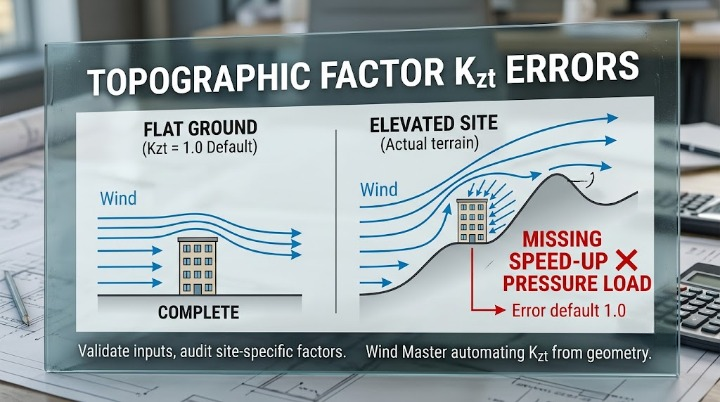
A wind load report built on a default topographic factor of 1.0 looks complete. It is missing an entire category of pressure the site is actually exposed to — and that gap will not surface until someone independently checks the site’s actual terrain.
The Assumption Hiding in Plain Sight
ASCE 7-16 requires accounting for topographic speed-up effects on sites situated on hills, ridges, or escarpments — locations where wind accelerates as it flows over elevated terrain, producing pressures meaningfully higher than the base calculation would predict on flat ground.
The topographic factor, Kzt, defaults to 1.0 for sites without qualifying topographic features. The risk is not in this default value itself — it is in engineers applying the default without first verifying whether the site actually qualifies for topographic speed-up consideration in the first place.
Where This Goes Wrong in Practice
A project situated on a hillside, near a ridge, or adjacent to an escarment triggers specific code criteria for topographic factor calculation — criteria based on the hill’s height-to-length ratio, the site’s position relative to the crest, and the direction of the prevailing wind relative to the terrain feature.
Engineers unfamiliar with these criteria, or working under time pressure, frequently apply the default factor of 1.0 without checking whether the site’s terrain actually qualifies for evaluation under the topographic provisions. The result is a wind pressure calculation that is complete in structure but missing an entire physical effect the site is genuinely exposed to.
The Consequence of an Ignored Speed-Up Effect
Wind speed-up over topographic features is not a marginal adjustment — depending on the terrain geometry, the topographic factor can meaningfully increase the effective wind speed used in pressure calculations. A report that defaults to 1.0 on a site that should have triggered topographic evaluation is not slightly conservative or slightly unconservative — it is missing a real physical loading condition the structure will actually experience.
This is precisely the kind of error that does not surface during a cursory internal review, because the report is procedurally complete. It surfaces during a rigorous peer review, or worse, after construction, when facade performance under actual site wind conditions diverges from the calculated design basis.
Calculating Kzt From Actual Site Geometry
After explaining how topographic speed-up effects are systematically ignored on elevated sites — not because the code is unclear, but because the qualifying criteria are easy to overlook under manual review — the fix is building the topographic check into every calculation by default rather than relying on an engineer to remember to evaluate it. Wind Master’s topographic factor module calculates Kzt based on the specific site geometry entered, flagging when a site’s characteristics warrant topographic evaluation rather than defaulting silently to 1.0.
Validate your topographic inputs — Audit your site-specific factors.