
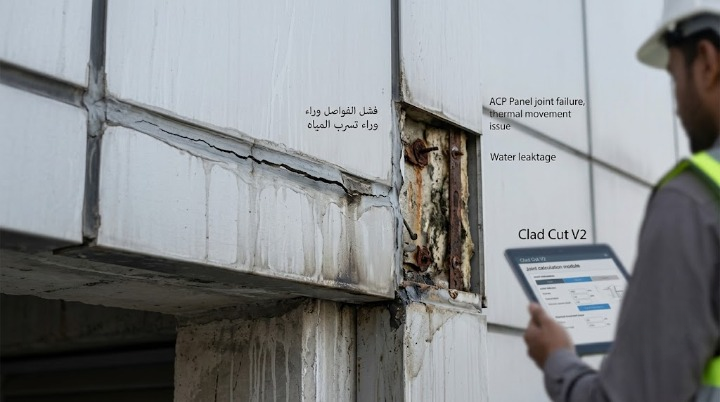
Building owners discovering water damage behind ACP facades years after installation often trace the cause to joint sealant failure from joint width calculations that did not account for thermal movement.
Why Joint Width Serves Two Purposes Simultaneously
A facade panel joint must accommodate both waterproofing — through sealant or a properly designed drainage system — and thermal movement, since the panel expands and contracts with temperature. A joint width calculated for waterproofing alone, without also verifying it accommodates the panel’s actual thermal movement range, risks the sealant being stretched or compressed beyond its functional capacity as the panel moves with temperature changes.
Where This Dual Requirement Gets Addressed Incompletely
Joint design that focuses primarily on waterproofing performance, without explicitly verifying the joint width also satisfies the sealant’s movement capacity given the panel’s actual thermal expansion range, can produce a joint that performs correctly under stable conditions but fails once real seasonal temperature variation exceeds what the sealant can accommodate.
Why This Failure Mode Remains Hidden for Years
A joint sealant failure caused by exceeding its movement capacity does not typically produce an immediately visible symptom — water infiltration behind the facade can accumulate gradually, causing corrosion, insulation damage, and mold growth that may not become apparent until years after the original installation.
Calculating Widths That Satisfy Both Thermal Movement and Sealant Capacity
After connecting joint width calculation to both thermal expansion and waterproofing performance, the fix is calculating joint width against both requirements simultaneously, rather than optimizing for waterproofing alone. Clad Cut V2’s joint design module calculates widths that satisfy both thermal movement and sealant movement capacity, addressing the root cause of facade water infiltration that a waterproofing-only calculation would otherwise leave unaddressed.
Validate your joint design — Calculate with Clad Cut V2’s joint module.