
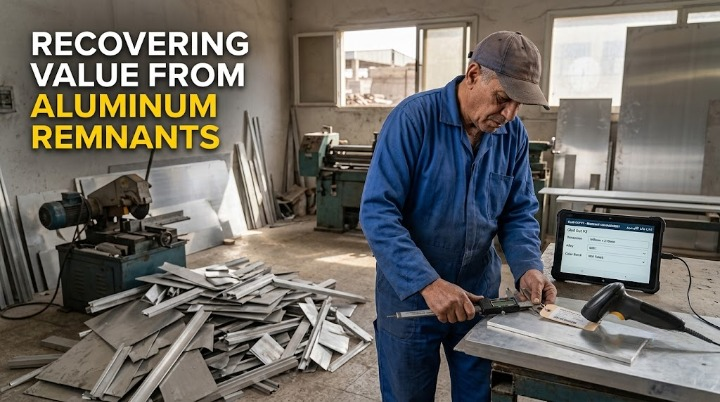
Workshop owners with piles of aluminum offcuts from previous jobs often have material that is technically reusable but practically lost, since nobody tracks exact dimensions, alloy, or color batch.
Why Untracked Remnants Represent Real, Recoverable Value
Offcut material from previous fabrication jobs retains real value if its dimensions, alloy, and color batch are known and can be matched to a future order’s requirements. Without systematic tracking, this value exists in principle but cannot actually be recovered, because nobody can confidently identify which remnant matches which future need.
Where This Value Goes Unrecovered
A workshop accumulating offcuts without a cataloging system effectively treats each remnant as unusable, defaulting to ordering new full sheets for every future job rather than checking whether an already-available remnant could satisfy the need — even though the remnant may be sitting in the same facility.
Why This Represents a Recurring, Compounding Loss
Every job that defaults to a new full sheet, when a suitable remnant was actually available but untracked, represents a specific, recoverable cost that recurs across every such missed opportunity — accumulating into a meaningful total loss across a workshop’s full order history.
Cataloging Offcuts by Dimension, Alloy, and Color
After identifying the value sitting in unmanaged remnant inventory, the fix is systematically cataloging offcuts so they can be matched against future nesting requirements, rather than treating them as effectively lost. Clad Cut V2’s remnant management system catalogs offcuts by dimension, alloy, and color, automatically including them in nesting calculations before allocating full sheets.
Audit your remnant inventory — Activate Clad Cut V2’s remnant management.