
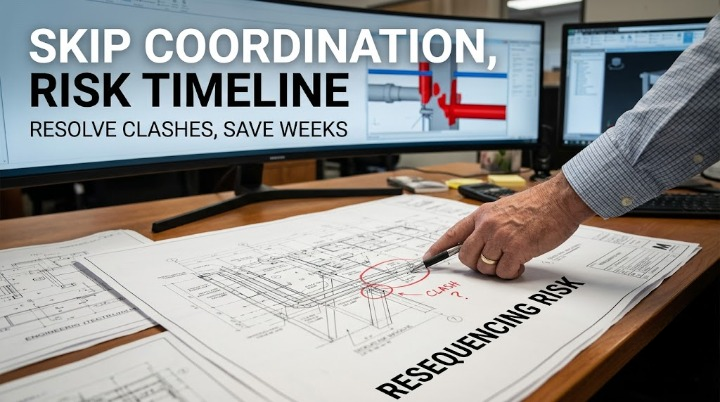
Project schedulers building a construction timeline without accounting for the resequencing risk that undetected clashes introduce may discover the impact only once a conflict forces work to be reordered mid-construction.
Why Schedules Often Do Not Account for Clash-Driven Risk
A construction schedule built on the assumption that coordination has been thoroughly resolved carries implicit risk if that coordination was actually incomplete — a risk that does not appear anywhere in the schedule itself, because the schedule assumes a clash-free sequence that pre-construction coordination was meant to guarantee.
Where This Risk Becomes a Visible Schedule Problem
If pre-construction coordination was skipped or incomplete, an undetected clash discovered during construction can force a resequencing of remaining work — a disruption the original schedule had no visibility into, because it was built on an assumption of coordination completeness that did not actually hold.
Why Resequencing Disruption Feels Sudden Even Though the Risk Was Foreseeable
Because the schedule never explicitly accounted for clash-driven resequencing risk, its sudden appearance during construction feels like an unforeseeable disruption, even though it was a foreseeable consequence of incomplete pre-construction coordination.
Protecting Schedule Certainty Through Pre-Construction Resolution
After tracing how undetected clashes convert into sudden schedule resequencing, DASH’s Navisworks clash detection protects schedule certainty by resolving conflicts before construction sequencing is locked in, addressing the resequencing risk before it becomes a mid-construction schedule disruption.
Consult with DASH’s team about protecting your construction schedule.