
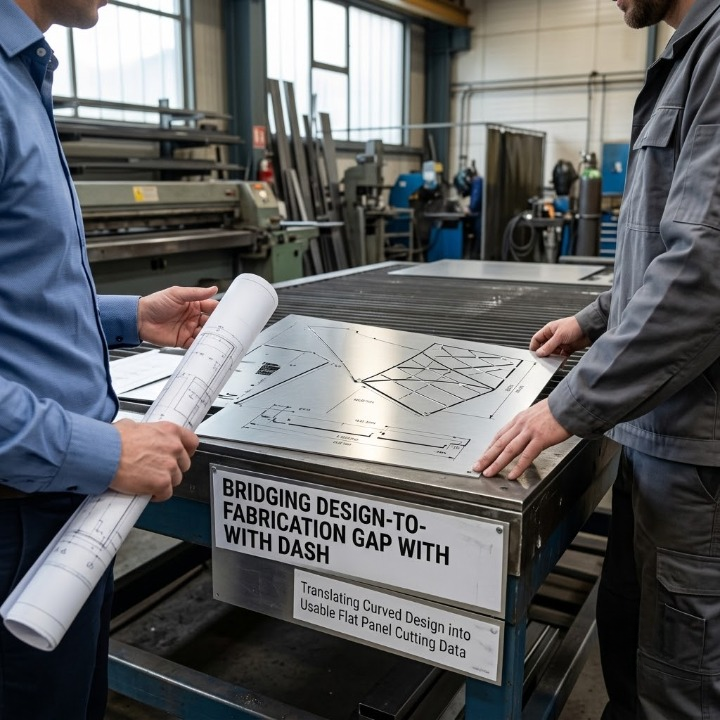
Architects issuing complex curved surface geometry that fabricators cannot directly interpret into flat panel cutting instructions creates a translation gap that consumes coordination time on every project.
Why Design Surfaces and Fabrication Geometry Are Different Languages
An architectural design surface is described in terms suited to design intent and visual representation. A fabricator needs that geometry translated into flat panel cutting instructions — a fundamentally different technical language.
Where This Translation Gap Consumes Coordination Time
Without a dedicated translation process, this gap gets bridged informally and repeatedly through back-and-forth clarification between architect and fabricator.
A Translation Layer From Design Surfaces to Fabricator-Usable Geometry
After identifying where architectural surface geometry and fabricator panel language diverge, DASH’s facade rationalization is the translation layer that converts design surfaces into fabricator-usable panel geometry.
Consult with DASH’s team about bridging your design-to-fabrication gap.