
In 2026, the boardroom conversation has fundamentally shifted. It is no longer a question of if a company should adopt artificial intelligence, but how quickly it can happen without compromising security or operational stability.
For many executives, there is a growing sense of “AI Anxiety”; board members are demanding a comprehensive strategy, yet many leadership teams find themselves without a clear, technical roadmap to execute it. Driving digital transformation with AI requires more than just a surface-level understanding of Large Language Models (LLMs). It necessitates a structural shift in enterprise adoption and the creation of AI-enabled business models that prioritize long-term digital maturity over short-term hype.
The 5-Step Roadmap for Enterprise AI Transformation
To transition from a legacy organization to an AI-driven enterprise, leaders must follow a structured innovation roadmap to ensure Technical Certainty.
| Step | Objective | Key Outcome |
| 1. Maturity Assessment | Audit existing IT infrastructure and data silos. | Identification of “Shadow IT” and team readiness. |
| 2. Data Foundation | Centralize operations into a unified Data Fabric. | Real-time, high-quality data for AI ingestion. |
| 3. Pilot Implementation | Select high-impact, low-risk use cases (e.g., admin automation). | Demonstrated operational efficiency and ROI. |
| 4. Scaling & Integration | Drive AI across CRM, ERP, and Support systems. | Unified, intelligent enterprise ecosystem. |
| 5. Continuous Optimization | Establish feedback loops within the SDLC. | Iterative improvements via autonomous AI agents. |
The Pivot: From Theory to Execution
Most business leaders are tired of hearing high-level concepts that don’t translate to their specific industry challenges. You don’t need another theoretical PDF report; you need a technical partner who executes.
Digital transformation with artificial intelligence is about solving real-world production bottlenecks with millimeter precision.
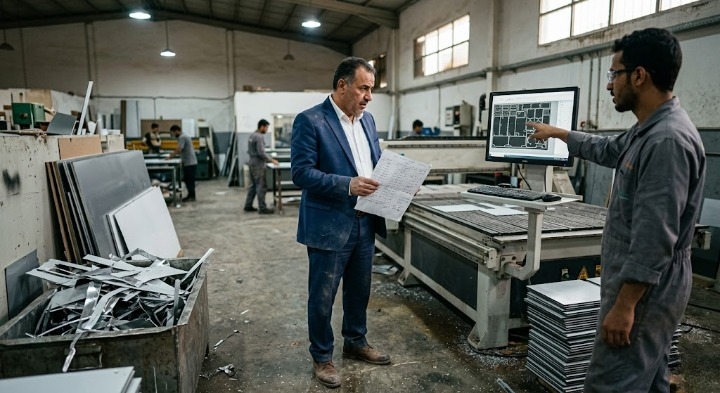
Case in Point: > Consider the fabrication of complex building materials like Aluminium Composite Panels (ACP). By applying AI-driven nesting algorithms to the production line, manufacturers can now reduce material waste by 15%. This isn’t just a technological upgrade; it is a direct increase in raw material yield and project profitability. This type of tangible execution is what separates market leaders from those left behind in 2026.
Scaling Your Enterprise with DomApp
The pressure to innovate can be overwhelming, but it is also an opportunity to outpace competitors who are stuck in legacy thinking. Leading a digital transformation means building a scalable ecosystem that allows your human talent to focus on qualitative strategy while algorithms handle the quantitative heavy lifting.
Schedule a Strategy Call
Stop navigating the complexity of AI alone. Let DomApp help you build the intelligent enterprise software you need to lead your industry.
Strategic Engineering Insight
Is your current executive team prepared to move from theoretical AI goals to a fully integrated technical execution, or are you still waiting for a “clearer roadmap” while your competitors are already claiming that 15% efficiency gain?
Would you like me to generate a technical prompt for a “2026 AI-Driven Factory” image to visually anchor this article on your site?