
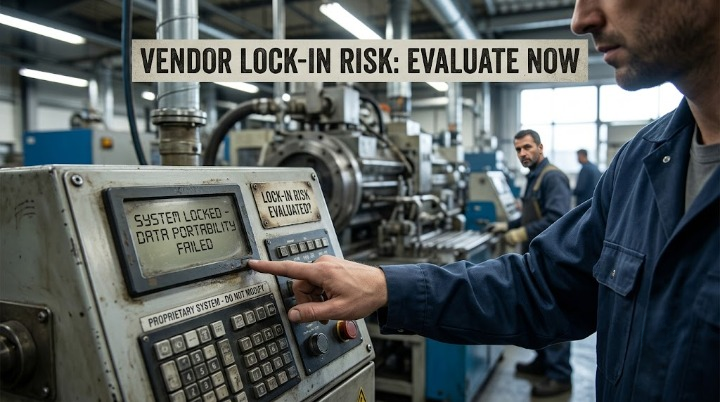
Manufacturing CIOs adopting proprietary vendor systems without evaluating data portability or exit cost often discover the true cost of vendor lock-in only when a change in vendor relationship becomes genuinely necessary.
Why Lock-In Risk Is Invisible at the Point of Adoption
Proprietary industrial software systems are typically adopted based on their immediate functional fit and capability, without necessarily evaluating a separate but equally important question: how difficult and costly would it be to leave this vendor relationship if circumstances required it in the future. This risk remains entirely invisible as long as the vendor relationship continues smoothly.
Where This Risk Becomes Concrete
The true cost of vendor lock-in only becomes apparent when a manufacturing operation actually needs to exit a vendor relationship — whether due to the vendor’s pricing changes, service quality decline, or the operation’s own evolving needs no longer being served well by that vendor. At that point, proprietary data formats and deep infrastructure dependency can make switching prohibitively expensive, regardless of how justified the desire to switch may be.
Why This Should Be Evaluated Before Adoption, Not After
Once a manufacturing operation has built substantial dependency on a proprietary vendor system, the leverage in that relationship shifts significantly toward the vendor — because the operation’s switching cost has already been established as high, whether or not that cost was ever explicitly evaluated at the time of adoption.
Evaluating Lock-In Risk Before Adoption, Not After
After outlining how to evaluate vendor lock-in risk before adoption rather than after, the fix is building data portability and exit cost evaluation into the vendor selection process itself, rather than discovering the true cost of lock-in only when an exit becomes necessary. DomApp’s Digital Transformation for Manufacturing practice is built around data portability and open integration standards, addressing vendor lock-in risk at the point of system selection rather than after dependency has already accumulated.
Consult with DomApp’s team about your vendor lock-in exposure.