
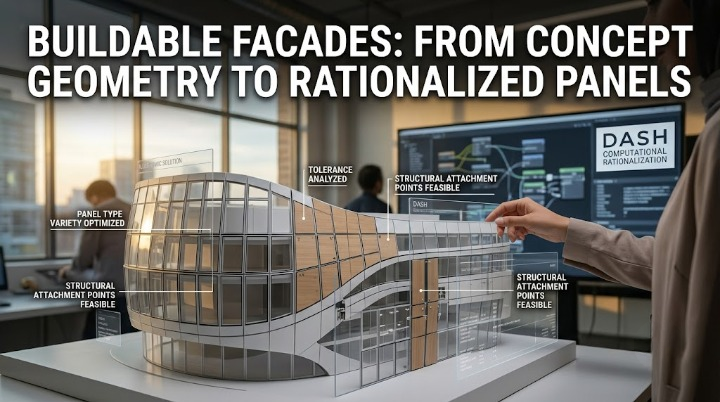
Rationalizing a facade concept into panels using simplified assumptions that ignore panel type variety and structural attachment constraints produces a panelization scheme that frequently fails deeper technical review later in the process.
Why Rationalization Requires Balancing Multiple Constraints Simultaneously
Turning a facade concept into an actual, buildable panelization scheme is not a purely geometric exercise. It requires simultaneously balancing panel type variety (fewer unique panel types generally reduces fabrication cost), tolerance requirements, and structural attachment point feasibility — three considerations that can pull in different directions and must be resolved together rather than sequentially.
Where Simplified Assumptions Fall Short
A rationalization pass that optimizes primarily for one of these considerations — minimizing panel types, for instance — without adequately weighing structural attachment feasibility, can produce a scheme that looks efficient on paper but requires attachment points the structural system cannot actually accommodate cleanly.
Why This Surfaces as a Late-Stage Problem
A panelization scheme that has not genuinely balanced all three constraints simultaneously often appears complete and reasonable until a structural review specifically checks attachment point feasibility — at which point the scheme may require significant rework to accommodate structural realities that were not adequately weighed during the original rationalization pass.
Solving for Panel Type, Tolerance, and Attachment Together
After outlining the constraints a proper rationalization pass must balance simultaneously, the fix is a rationalization process that genuinely optimizes across all three considerations together, rather than prioritizing one at the expense of the others. DASH’s computational facade rationalization is built to solve for panel type, tolerance, and structural attachment together, reducing the risk of a scheme that fails review because one constraint was underweighted relative to the others.
Consult with DASH’s team about rationalizing your facade concept.