
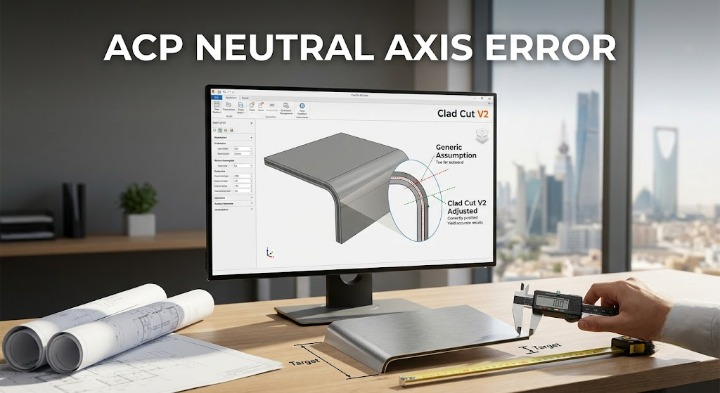
Quality control managers rejecting bent panels because final dimensions consistently fall short may not realize that the root cause is incorrect neutral axis positioning in the bending allowance formula.
Why Neutral Axis Position Determines Bent Dimension Accuracy
When material bends, the neutral axis — the line within the material’s thickness that neither stretches nor compresses during the bend — shifts based on material thickness and bend radius. If a bending allowance calculation assumes an incorrect neutral axis position, the resulting bend deduction will be wrong, and the final panel dimension will consistently miss its target in a predictable direction.
Where This Root Cause Gets Misdiagnosed
Quality control processes noticing that bent panels consistently fall short of target dimension may attribute the issue to material variation, operator technique, or machine calibration, without necessarily tracing the problem back to the specific neutral axis assumption embedded in the bending allowance formula being used.
Why This Produces a Systematic, Not Random, Error Pattern
Because the underlying cause is a formula assumption rather than random variation, the resulting dimensional shortfall recurs consistently across panels processed with the same incorrect assumption — a systematic pattern that points toward a calculation error rather than a manufacturing variance issue, once correctly diagnosed.
Adjusting for Specific ACP Compositions
After explaining neutral axis mechanics and how material thickness and bend radius shift it from the theoretical centerline, the fix is computing neutral axis position based on actual material composition rather than a generic assumption. Clad Cut V2’s automated neutral axis computation adjusts for specific ACP compositions, eliminating the systematic shortfall that an incorrect generic assumption otherwise produces.
Validate your neutral axis calculation — Audit Clad Cut V2’s bending logic.